May 2026: The Data Caught Up to the Vibes
Karpathy joined Anthropic. 91% of designers now use AI weekly. The $900 billion round closes this week.
Hello fellow designers, creatives, digital professionals, and Eidos Design members!
For about a year I’ve been making the same argument to you, mostly on the strength of stock moves and product demos: that the distance between designing software and building it is closing, and that the labs making the models are turning into the platforms that run everything on top of them. May is the first month I can make that case with figures instead of hunches.

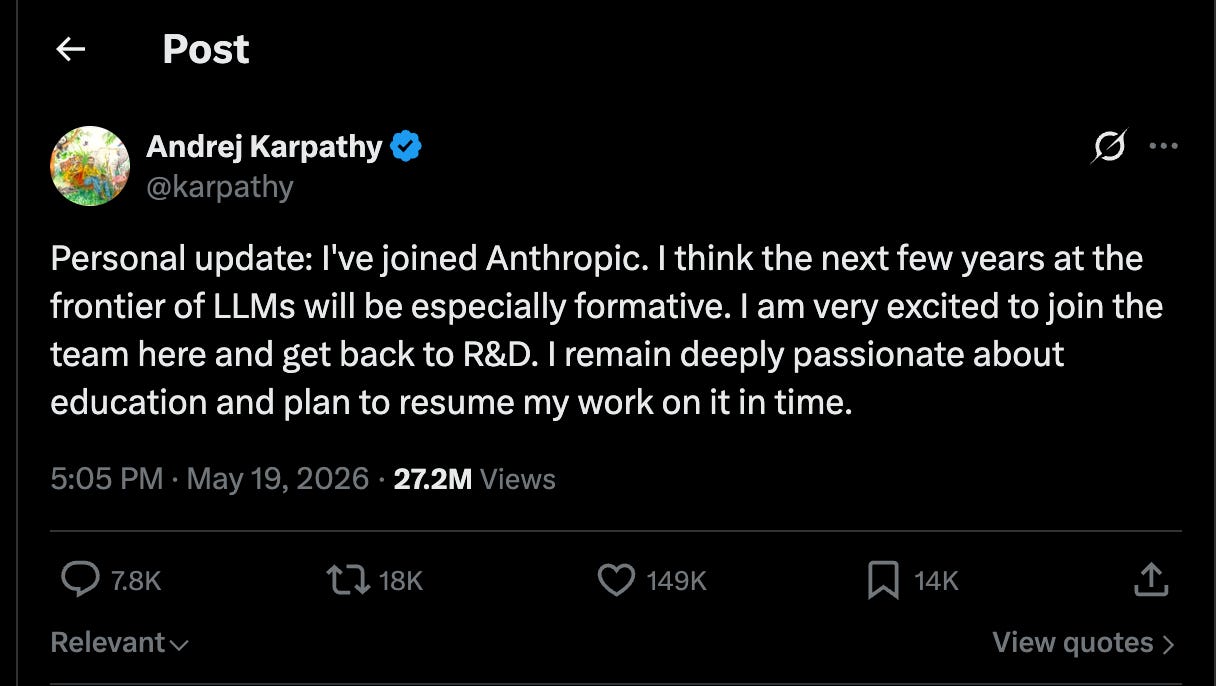
Karpathy's May 19 Announcement
On the morning of Tuesday, May 19, Andrej Karpathy posted nine sentences to X. He’d joined Anthropic. He thought the next few years at the frontier of large language models would be unusually formative. He was glad to be back doing research, and his education project was paused for now. By the end of the day the post had 148,000 likes, which tells you how closely this particular career gets watched.
A little background, because the moves are the point. Karpathy is one of OpenAI’s eleven original co-founders. He left in 2017 to run Tesla’s autopilot program, returned to OpenAI in early 2023, left again about a year later, and spent the stretch after that building an education startup called Eureka Labs. He could have gone back to OpenAI a third time and would almost certainly have been welcomed. He chose Anthropic.
His job there is narrow and, if it works, enormous. He’s joining the pre-training team under Nick Joseph to build a group that uses Claude to speed up the research that produces the next Claude. Anthropic confirmed that scope to TechCrunch and VentureBeat. The wager underneath it is that the next leap in capability comes less from pouring in more compute and more from models that make their own researchers faster. Hiring the person most associated with explaining how these systems actually get built, then pointing him at that exact problem, is a fairly literal way to place that bet.
It wasn’t the only hire that week. Anthropic also brought on Chris Rohlf for its frontier red team, out of a twenty-year security career that included six years at Meta and earlier time on Yahoo’s “Paranoids,” and the Musk versus Altman trial wrapped with a jury siding with Altman. The talent and the legal weather both broke Anthropic’s way inside the same five days.
Figma’s own AI agent on the canvas, launched May 20, the same day the Designer Fund report dropped.
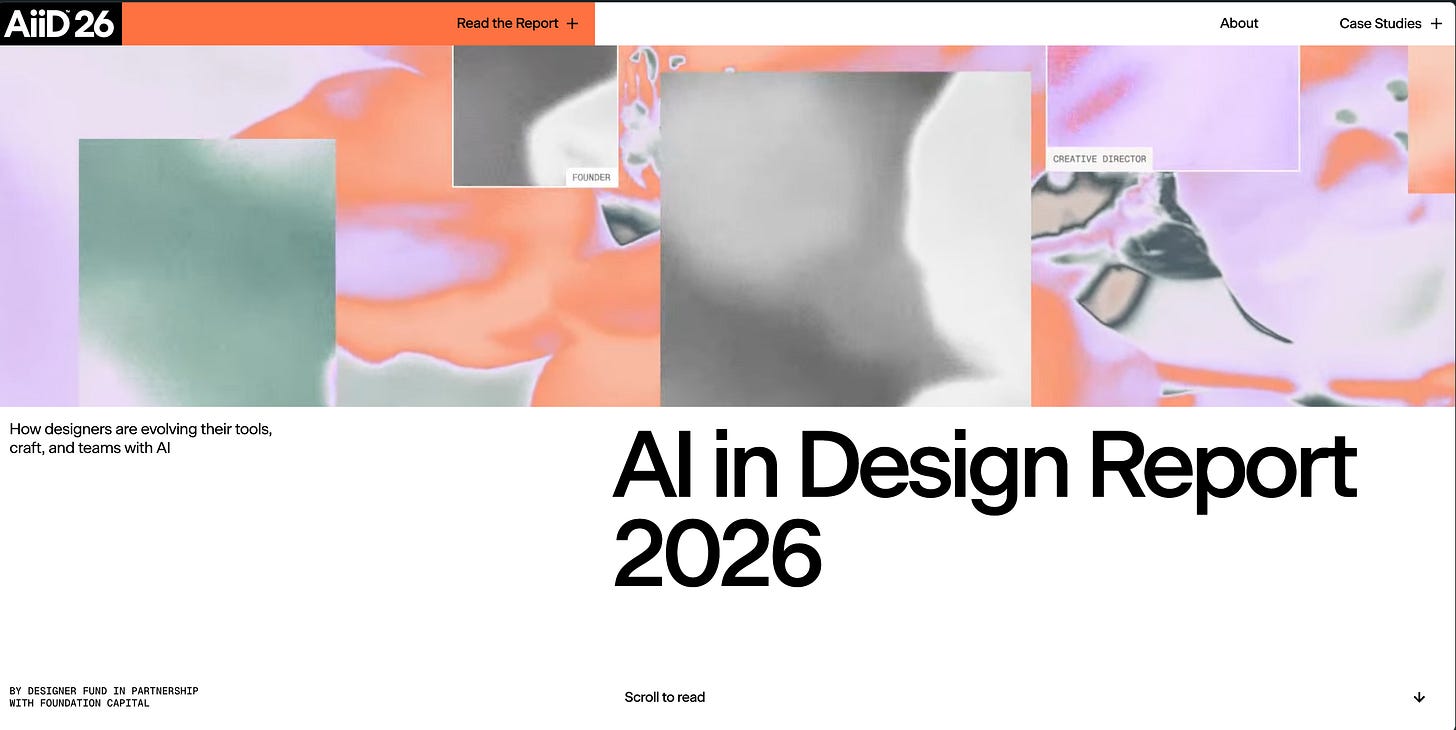
Designer Fund and Foundation Capital published the second annual AI in Design report on May 20. They surveyed 906 designers across more than 60 countries and ran a couple dozen interviews with people at Anthropic, Stripe, Linear, Notion, Cursor, Ramp, and a long tail of startups.
The number in the section title is the headline. Weekly AI use among designers went from 54 percent a year ago to 91 percent now. Three-quarters use it daily. The average person’s stack of AI tools doubled, from three to seven. And the figure I keep turning over: half of everyone surveyed, brand and product designers included rather than only the engineering-leaning ones, has shipped AI-generated code to production. At early-stage companies it’s 68 percent.
Claude leads the tools at 78 percent, ahead of ChatGPT at 65. Claude Code, which didn’t exist publicly a year ago and wasn’t even on the 2025 survey, already sits in roughly two-thirds of stacks.
The fifty-percent figure is higher than I’d have guessed, and it reads differently from a normal adoption stat. Shipping code to production isn’t the same as trying a tool over a weekend. It means the work crossed a line that used to need a different job title on the door.
The report is honest about the cost sitting inside the gains, and that’s the part I’d dwell on if I ran a team. Designers say they’re picking up more product and engineering work. They also say they’re collaborating less, and that figure has risen sharply over the year. Each person reaches further while fewer hands touch the same problem. Most companies, the report notes, haven’t adjusted their review processes, team shapes, or hiring criteria to match any of it, and the designers who feel good about the shift tend to be the ones whose employer actually paid for it instead of leaving it to nights and weekends.
Anthropic is a disclosed partner on this survey, and the survey’s headline finding is that Anthropic’s product won. That doesn’t make the number wrong. Ramp, whose AI Index tracks real business card spend rather than self-reports, caught the same crossover in April, with Claude passing ChatGPT among US businesses 34.4 percent to 32.3. But a survey funded in part by the company it crowns is not independent research, and the report itself admits the designers who answered it are probably heavier AI users than designers in general, which would push the numbers up. Treat it as a strong signal from people who stand to benefit if it’s true. Useful, but not neutral.
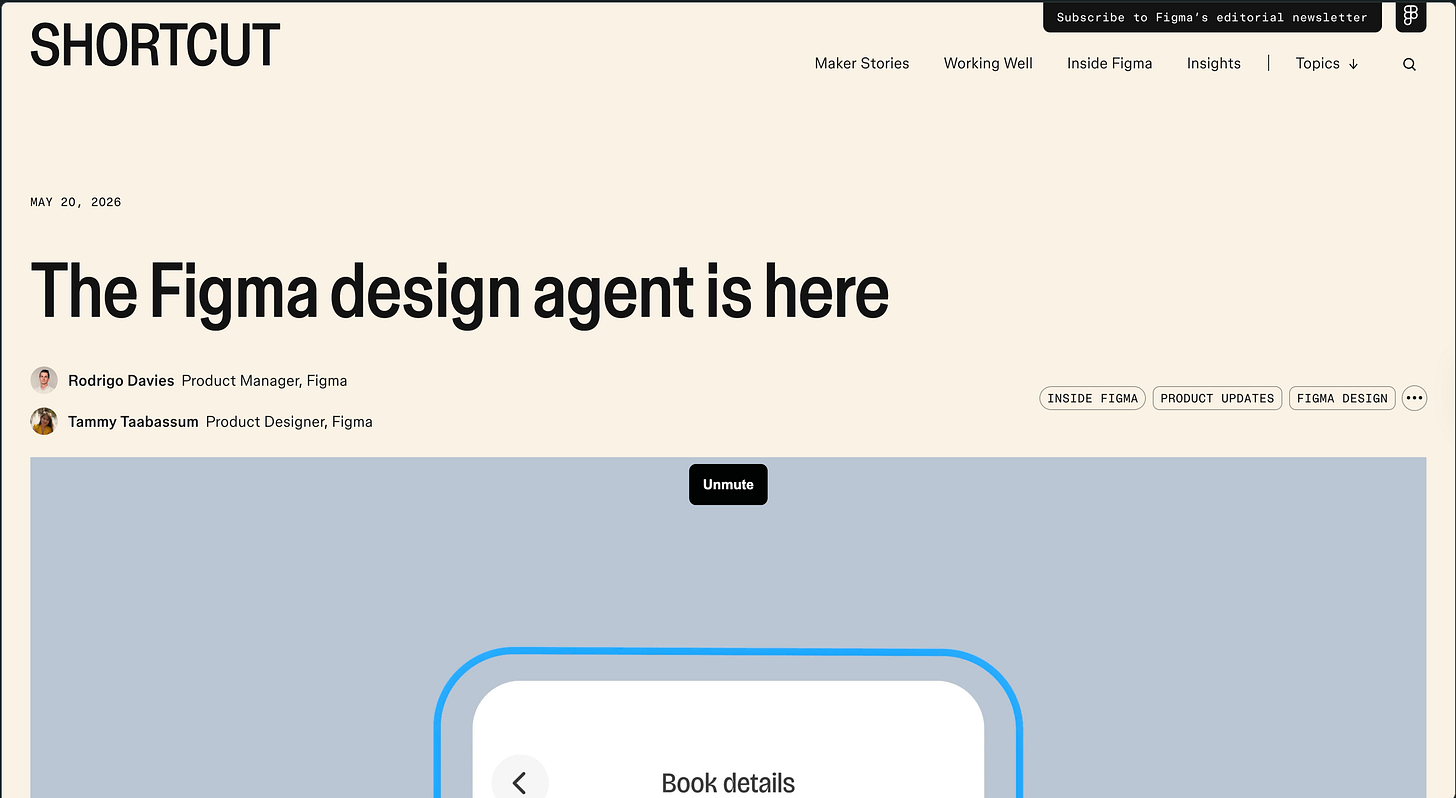
Figma’s own AI agent on the canvas, launched May 20, the same day the Designer Fund report dropped.ion.
The same day that report landed, Figma shipped an AI agent that works directly on the canvas, in beta for paid seats. You describe what you want, and it generates and edits real layers, applies your design system, and works inside the file next to you rather than off in a side panel. It can also hand a build off to Claude Code or OpenAI Codex through Figma’s MCP server. Loredana Crisan, Figma’s chief design officer, pitched it around judgment: as building gets cheap, she said, the scarce skill becomes deciding what to make and how it should feel.
The timing is what makes it worth a section. Five weeks earlier, Mike Krieger had stepped off Figma’s board, and three days after that, Anthropic launched Claude Design, its own tool for generating interfaces. The easy read was that Anthropic was coming for Figma. Then Figma reported its first full quarter as a public company: revenue up 46 percent to $333 million, net dollar retention at 139 percent, the count of customers spending over $100,000 a year up 48 percent. The stock climbed on the news.
So the cannibalization story isn’t holding, at least not yet, and what’s happening instead is more specific. The company that already owned the canvas put an agent on it, while the labs aim their generative tools at people who were never going to open Figma in the first place. Figma keeps the designer in the director’s chair, which is the part of the job that pays. A falling stock price and a strong product are not the same thing, and the market seemed to figure that out within the hour.
Thanks for reading Eidos Design | UX AI Community! This post is public so feel free to share it.
That money has to come from somewhere, and a lot of it is coming out of payroll. Tech layoffs passed 113,000 for the year by May 18, by Challenger, Gray and Christmas’s count, and for the second month running AI was the reason companies named most often when they cut, accounting for 26 percent of April’s tech total.
Meta ran the single biggest cut of the year on May 20: 8,000 people, around a tenth of the company. The memo, from chief people officer Janelle Gale, described it as running leaner to pay for the investments being made elsewhere, which is at least candid about the trade. Roughly 7,000 staff were moved onto AI teams and 6,000 open roles were cancelled. Content design was among the functions hit.
Two weeks before that, Cloudflare cut about 1,100, a fifth of its workforce, with a memo noting that AI usage inside the company had jumped more than 600 percent in three months. Investors didn’t read it as the confident pivot it was dressed up to be. The stock fell 24 percent the next day, the worst single session in the company’s public life. Intuit, Cisco, Coinbase, Oracle, and PayPal all trimmed as well, several of them reaching for the same AI framing.
Set against the cuts is the spending they help fund. Google, Microsoft, Meta, and Amazon plan to lay out $725 billion in capital expenditure this year, up 77 percent, most of it on AI infrastructure. The Financial Times line that got passed around came from Jefferies’ Brent Thill, who called the bear case “garbage” and the AI economy healthy.
Nobody can say yet how much of this is AI genuinely doing the work and how much is AI as a convenient excuse for cuts companies wanted regardless. The evidence so far leans toward excuse. Oxford Economics found that firms aren’t really replacing workers with AI at any scale. Wharton’s Peter Cappelli was blunter: companies keep saying AI will do the work, mostly can’t prove it does, and are hoping. Even Sam Altman has admitted as much. And Andy Challenger, whose firm counts these layoffs, put it most simply: budgets are moving toward AI and away from people. A job doesn’t have to be replaceable by AI to lose its budget to it.
As a designer, that’s the risk I’d actually watch. It’s quieter than “the robots are coming for your job,” and a lot more likely to be what actually happens.
👉 After Automation, by Dan Shipper. The strongest single piece I read all month, published May 21. AI commoditizes yesterday’s competence, that abundance breeds sameness, and the demand for anything that breaks the sameness becomes the new demand for human experts.
👉 Shipper on Lenny’s Podcast, May 24. The same thinking as a conversation, with a set of deliberately contrarian calls attached: SaaS isn’t dead, CLIs are over, the forward-deployed engineer is the hire that matters now, and “automation is a lie.” Watch this if the essay leaves you wanting the longer version.
👉 DesignerTom: “How I Built an AI Agent That Designs Like Me.” Tommy Geoco walks through the actual agent setup running his studio, posted May 1. A four-agent harness, the seven-file anatomy of an OpenClaw agent, the four layers that make one useful (skills, memory, context, connections), and a path to build your own. He’s clear about what it does and doesn’t handle on a given day, which is rarer than it should be.
👉 Neuma: build your personal AI by talking to it. A self-paced course from Kris Puckett, a design manager at Stripe. Nine modules, no coding required, building toward a personal system in Claude Code with persistent memory, daily briefings, and a coaching layer. The price climbs to $179 on June 1.
👉 Design Motion Principles, by Kyle Zantos. An open-source skill for Claude, Cursor, and Windsurf with two modes: build interactive components with motion, or audit the animations you already have. The audit runs a checklist for the fingerprints of AI-generated motion, like pulsing indicators, hover-scale on everything, and bouncy springs slapped on utility actions. Distilled from the published work of Emil Kowalski, Jakub Krehel, and Jhey Tompkins.
👉 Lenny’s “Essential books for product builders,” part one. Thirty-six books sorted by the job you’re hiring them to do, posted May 26, three per category across roughly a dozen disciplines. Lenny leans on Marc Andreessen’s rule of mostly reading books more than ten years old, which feels right in a month this loud.
I came into May looking for a throughline and mostly got tables of numbers, so here’s my honest attempt to say what they add up to.
The argument I’ve been making in pieces for a year now has a figure attached to it at last. When 91 percent of designers use AI every week, half of them ship code, and the tool most of them trust is one a frontier lab is openly working to make smarter, I no longer have to argue that design work and software work are merging. The survey shows people already living it, on ordinary Tuesdays, in production. The designers getting ahead are the ones treating code as a material they can shape themselves rather than a spec they describe and pass to someone else.
The number I’m less sure how to feel about is the collaboration one. Designers are reaching further on their own and working together less, and that climbed fast this year. I don’t know what we lose when more of the work moves into a quiet exchange with a model and out of a noisy room with other people. Maybe it’s a fair trade. Or maybe we’re losing something in those rooms that no survey will catch until it’s already gone. I genuinely can’t tell yet, and I’d rather say so than pretend the gain comes free.
The cleanest evidence we have for the biggest shift in design tooling in a decade is also tangled up with the people who profit from it. I’d hold both of those at once: that it’s probably right, and that it’s not disinterested.
The one thing I’d resist is treating all of it as a tooling story. Learning the new stack is the easy part, and a year from now it’ll be the floor rather than the edge. What the reports can’t measure, and what the agents still can’t do, is judgment. So the question I’m actually leaving May with is how any of us keeps getting sharper at the judgment part while the tools race ahead and make everyone look equally capable. I can’t answer that one yet, and I suspect it matters more than anything on a tool stack.
June has the Anthropic round closing, Figma’s Config, and whatever the next surprise turns out to be. I’ll see what it adds up to and write you then.
If this edition gave you something to think about, pass it to someone who needs to read it. And subscribe if you haven’t yet.
Sincerely, Mykola Korzh