March 2026: Trust Is the Product Now
The Pentagon split AI’s biggest companies apart, Figma opened the canvas to agents, and 1.5 million users proved that values are a product decision.
Hello fellow designers, creatives, digital professionals, and Eidos Design members!
Mykola here. March got political.
This month’s stories connect through one thread: trust turned into a product decision. An AI company said no to the Pentagon and became the most downloaded app in America. 45,000 tech workers lost their jobs to a forecast. Figma opened the canvas to agents. And 1.5 million users proved they’ll choose tools based on values, not just features.


Anthropic CEO Dario Amodei drew two red lines the Pentagon wouldn’t accept. The company sued the federal government on March 9. Photo: AP Photo/Markus Schreiber, AP Photo/Mark Schiefelbein via Euronews.
Anthropic signed a $200 million contract with the Pentagon in July 2025 and was the first AI lab to deploy on the agency's classified networks. Negotiations broke down when the Pentagon wanted Claude on its GenAI.mil platform without restrictions. CEO Dario Amodei drew two red lines: no mass surveillance of U.S. citizens, and no autonomous weapons fire. On February 27, the Pentagon designated Anthropic a "supply chain risk," blocking federal agencies and military contractors from using Claude. That label is reserved for Chinese state-affiliated firms. The next day, OpenAI signed a deal to provide AI services on those same classified networks.
The public responded within hours. The #QuitGPT petition gathered 1.5 million supporters. ChatGPT uninstalls surged 295% overnight. On March 3, Sam Altman told CNBC: "We were trying to de-escalate things and avoid a much worse outcome, but I think it looked opportunistic and sloppy." He amended the contract.
Claude hit number one on the U.S. App Store on Saturday, March 1. Daily signups broke all-time records for a week straight; paid subscribers more than doubled since January.
On March 9, Anthropic filed two federal lawsuits against the Trump administration. Dozens of employees from OpenAI and Google DeepMind, including Google chief scientist Jeff Dean, signed a public brief supporting their competitor. Microsoft filed its own supporting brief. Pentagon CTO Emil Michael responded on March 12: Anthropic would "pollute" the defense supply chain. An AI accountability march was organized for March 21 in San Francisco.
I want to be careful here. MIT Technology Review makes a credible case that Altman's amended contract doesn't prevent the surveillance use cases that triggered the backlash. Court filings from March 20 revealed the Pentagon told Anthropic the two sides were "nearly aligned," one week after Trump declared the relationship over. There are layers to this that a petition can't capture.
And yet: 1.5 million people made a product decision based on values. They didn't need a manifesto. One announcement showed them what the product stood for, and they acted.
I use Claude daily. I’ve built my workflows around it. I’m not American, and I don’t follow US defense politics closely. But I understand risk. Anthropic walked away from a Pentagon contract, got blacklisted, and sued the federal government. That costs real money and real relationships. Most companies would’ve quietly signed and moved on.
It doesn’t make Claude a better model. But it makes me trust the people building it more. I’m more willing to put client work through it, more willing to recommend it, more willing to build long-term workflows on top of it. That’s what trust as a product feature actually looks like in practice.
While all of this played out, Anthropic kept shipping. On March 20, Claude Code Channels launched with Telegram and Discord integration. You can message Claude Code from your phone and get results back. It’s Anthropic’s direct counter to OpenClaw. On March 23, Claude Cowork gained computer use: Claude can now control your Mac, open apps, navigate browsers, fill spreadsheets. Dispatch lets you assign tasks from your iPhone, walk away, and come back to finished work. The company that said no to the Pentagon is also the one whose AI can now operate your computer while you sleep.
Build systems where the values are visible from the first interaction. "AI ethics transparency" is now a concrete UI discipline: communicating what the model will and won't do, before the user finds out in a crisis. The patterns for this don't exist yet.
Q1 2026 tech layoffs reached 45,000 globally, with 20.4% explicitly linked to AI and automation (layoffs.fyi). Photo: Lummi.
Q1 2026: 45,000 tech layoffs globally, over 30,000 in the U.S. Amazon leads with 16,000 cuts. Meta trimmed 1,500 from Reality Labs. Block fired 4,000 people on March 1. That’s 40% of the company. Jack Dorsey built an internal AI agent called Goose over 18 months and decided the company can run with 6,000 instead of 10,000. Stock surged 20%. Atlassian followed on March 11, cutting 1,600 to “self-fund” its AI push, with cloud revenue up 26% and its Rovo AI assistant at 5 million monthly users. They were growing when they made the cuts.
Harvard Business Review published a study by Davenport and Srinivasan, surveying 1,000+ executives. Companies are reducing headcount in anticipation of AI's future impact, even though AI hasn't proven it can do those jobs. The layoffs are real. The AI replacement is speculative. CEOs at Ford, Amazon, Salesforce, and JP Morgan Chase have declared white-collar jobs will "soon disappear," and they're acting on that belief before the technology delivers proof.
Jason Lemkin at SaaStr coined the phrase "invisible unemployment": companies don't fire people for AI. They don't backfill when people leave. 66% of CEOs surveyed plan to freeze team size or reduce headcount in 2026. Oxford Economics calls these AI layoffs "convenient corporate fiction."
Both things are true at once. Companies are using AI as cover for restructuring they'd want to do anyway. And AI is making some roles redundant. Those two facts don't contradict each other. They make the math harder to read.
Lenny Rachitsky’s State of the Product Job Market report tells the design-specific story. Roles crashed from nearly 10,000 in early 2023 to a low of 4,341. They’ve since climbed back 32% to about 5,716. PM and engineering both bounced back after ChatGPT’s initial shock. Design is recovering, but it’s the slowest discipline to come back. The ratio of open PM roles to designer roles flipped in mid-2023 and keeps widening (PMs now at 1.27x). Lenny’s theory: AI lets engineers move so fast there’s less opportunity and less desire to involve the traditional design process.
NN/g’s State of UX 2026 describes who survives the compression: “adaptable generalists who treat UX as strategic problem solving, rather than deliverable production.” Junior designer roles are vanishing. Entry-level UX positions are disappearing while senior roles demand breadth across research, strategy, and AI interaction design.
You either work with AI tools or compete for a shrinking pool.
Three screens, same headline. Perplexity shipped the agent, OpenAI shipped the tools, Anthropic shipped the question. Photo: Lummi.
On March 11, 2026, three companies shipped three different visions of the same AI moment. Same day.
Perplexity announced "Everything is Computer.". It integrates with Gmail, Outlook, GitHub, Linear, Slack, Notion, Snowflake, Databricks, Salesforce. Perplexity's internal study of 16,000+ queries claims $1.6 million in labor costs saved, 3.25 years of equivalent work, in 4 weeks. (I'll note: those are self-reported figures. The methodology for converting queries to "years of work" isn't transparent. Treat as a marketing claim until someone else verifies it.)
OpenAI published new agentic primitives in its Responses API, giving developers tools to build autonomous agent workflows.
Anthropic launched The Anthropic Institute, consolidating its Frontier Red Team, Societal Impacts, and Economic Research teams under one roof. Co-founder Jack Clark leads as Head of Public Benefit. They hired Matt Botvinick from Google DeepMind and Yale Law School to work on AI and rule-of-law.
Perplexity shipped the agent. OpenAI shipped the tools. Anthropic shipped the question of whether either is safe.
Perplexity's CEO Aravind Srinivas put it this way: "When you have highly accurate AI search, an orchestration harness of 20 frontier models, and agentic internet access, AI is the computer." That's a product thesis, and the rest of the industry is heading the same direction. An always-on computer that acts for you while you're asleep.
The shift is from designing interactions to designing trust signals, audit trails, and "what happened while you were away" dashboards. Ambient computing requires ambient design. Most teams haven't started building it. The interface for a computer that acts on your behalf while you're gone is a new design brief, and the patterns for it are unwritten.
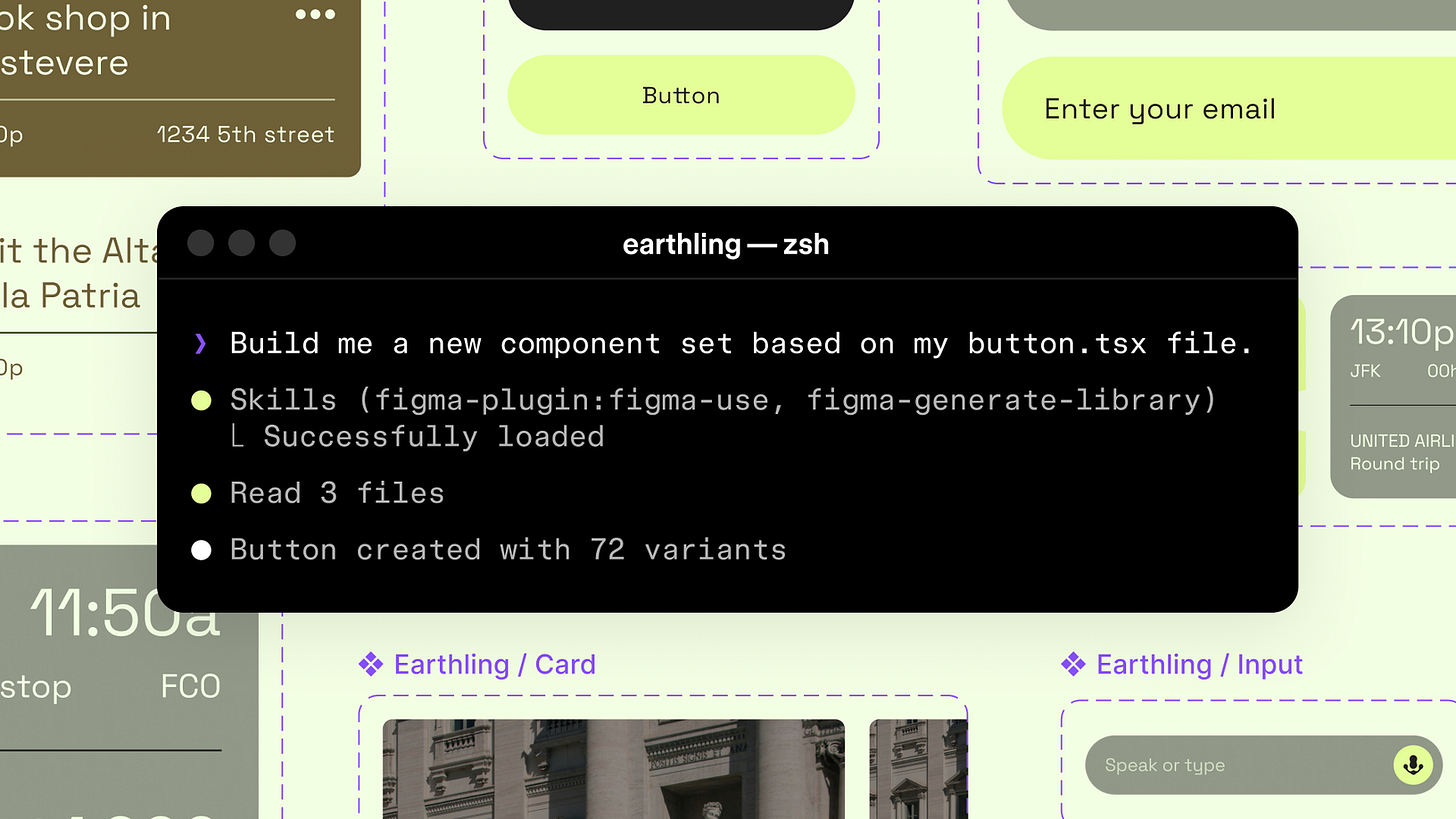
Figma opened the canvas to agents on March 24. Paper already shipped write access on March 5. Source: Figma blog.
On March 11, Figma launched its AI credits monetization model. On March 18, hard enforcement of monthly seat credit limits began. Full seat users on Professional plans get 3,000 AI credits per month. Organization and Enterprise plans can now enable pay-as-you-go. Professional plan support for that? Delayed to May 2026.
Morgan Stanley analyst Elizabeth Porter calls Figma "the industry standard." Design community forums tell a different story. Users report Dev Mode seat costs could increase 10x. FIG stock is at $21.78 as of March 24, down 85% from its post-IPO peak of $142.92 on August 1, 2025, and below its $33 IPO price.
Figma also acquired Payload CMS to accelerate its content management roadmap. Figma Sites now supports collections, CMS pages, and CMS lists, though it still lacks nested URL structures, a public API, and content staging.
Then, on March 24: Figma opened the canvas to agents. The new use_figma MCP tool gives Claude Code, Codex, Copilot CLI, Augment, Factory, Firebender, and Warp direct write access to Figma files. Agents can create and modify frames, components, variables, and auto layout, all wired to your existing design system. Figma also shipped “Skills,” markdown files that teach agents your team’s conventions and sequencing. Nine example skills launched on day one, including ones from practitioners at Uber and OpenAI. Free during the beta, usage-based pricing later.
This is a sharp reversal. On March 6, Figma’s MCP server was read-oriented. On March 24, it’s read-write. The speed matters. Paper launched its desktop app and MCP server on March 5 with 24 bidirectional tools and a code-native HTML/CSS canvas. Figma took 18 days to match on write access. Paper’s advantage is still architectural. Everything renders as real flexbox, real CSS properties, no conversion layer. Its MCP was write-capable from day one. Figma’s advantage is the installed base and the design system graph that millions of teams already maintain there. And Framer cut Figma-to-web production time by 70% via its 2026 Import Engine. All three are positioning as the agent-era design layer.
Figma's State of the Designer 2026 report says 91% of designers say AI improves their designs, and 89% are working faster. Frustration is concentrated in graphic design and illustration, where daily AI use sits at 40% compared to 65% for web developers.
I covered Figma’s valuation correction in January and its bet on taste in February. I wrote about Paper back in September when it opened signups. The pitch then was closing the gap between what designers create and what developers build. The pitch now is bigger: a design canvas that’s natively agent-ready, where your AI tools read, modify, and push changes back into the canvas directly. Figma just made the same bet, and it did it in 18 days. The race now is about which agent-first architecture wins.
Your tool choice is a strategic decision. Try both. Paper’s code-native canvas eliminates the design-to-code handoff entirely. Figma’s canvas write now lets agents build with your existing design system as source of truth. Framer’s Figma import makes switching cheaper than it was six months ago. The window to evaluate is open right now. Pricing structures will harden by summer.
👉 Scott Barker: How to Prepare for the Next Decade. Barker calls the 2020s “the Acceleration Decade” and offers ten ways to move through it with some peace and equanimity. Over 200,000 reads. Useful framing for anyone whose job description has changed three times since 2023.
👉 Lenny Rachitsky × Jenny Wen: The Design Process Is Dead. Jenny Wen is head of design at Claude and previously led FigJam and Slides at Figma. She argues the classic discovery-mock-iterate cycle is obsolete. Designers should act like internal VCs, spotting prototypes with energy around them that nobody can articulate yet and translating them into products. She covers her AI tool stack, the three archetypes she’s hiring for, and why chatbot interfaces may be more durable than most people expect. 77 minutes, worth the full listen.
👉 Soleio’s Design Hiring Playbook, packaged as an AI agent skill. An installable Claude Code skill that operationalizes Soleio’s design talent framework. Two modes: one for founders sourcing designers, one for designers positioning themselves. The insight: top design talent never responds to job postings. The skill helps both sides close that gap.
👉 Fin.ai: We Gave Claude Code to Everyone at Intercom. Not Just Engineers. Intercom rolled out Claude Code company-wide, equipped with internal skills and integrations. The finding: when non-technical people get the same tool engineers use, enhanced with company-specific intelligence, they don’t just use it. They build with it. Intercom calls this a structural change in how organizations work, not a productivity story.
👉 Paper Snapshot: capture production UI, paste it into Paper as editable layers. Chrome extension that grabs real HTML/CSS from any live page and drops it into Paper’s canvas. No screenshots, no conversion. Grab something from prod, paste it in, let Claude spin up six variations. The design-to-code gap works in reverse now.
👉 Linear: A Calmer Interface for a Product in Motion. Charlie Aufmann and Maxime Heckel walk through Linear’s latest UI refresh. The core moves: dim the sidebar so it stops competing with your content, compact the tabs, simplify the icons, soften the borders. A two-person team shipped it using coding agents and internal tooling (a dev toolbar with feature flag toggles, a custom theme editor that exports token values as JSON). They see it as preparing the interface for agentic workflows. Worth studying for the process as much as the result.
👉 Karl Koch: 10 Principles for Fluid UI. The best design engineering article I’ve read this month. Physics-based motion over time-based easing. Every animation must be interruptible. Direct manipulation over indirect control. Velocity preservation across gesture boundaries. Each principle has an interactive demo you can play with on the page. Published in February, updated March 23. Bookmark this one.
👉 Agentation: visual feedback for AI coding agents. Click any element in the browser, write your feedback, and Agentation generates structured Markdown with CSS selectors, source file paths, React component tree, and computed styles. Your agent knows exactly which element you mean and where to find it. MCP integration lets agents read annotations in real time and respond back. Free for internal use. By Benji Taylor, Dennis Jin, and Alex Vanderzon. v3.0.1.
1. Audit what your AI product refuses to do, and make that visible in the first interaction. The QuitGPT movement proved that 1.5 million users form product opinions based on values. If your product uses AI, its limits and refusals should be accessible from the first screen. Build a prototype of an "AI ethics card" that communicates what the model will and won't do.
2. Prototype a “what happened while you were away” dashboard for any agentic tool you’re working on. Perplexity’s always-on computer, Cursor’s background agents, and Claude’s new computer use all point to the same pattern: AI acts while you’re away. The interface for reviewing those actions is the defining design problem for agentic tools in 2026. Start sketching it now.
3. Test agent-driven design this week. Both Figma and Paper now let AI agents write directly to your canvas. Try Figma’s new use_figma MCP tool with your existing design system (it’s free during beta). Download Paper’s desktop app and connect its MCP server to Claude Code or Cursor. Spend an hour with each. The agent-era design stack is forming right now, and the evaluation window won’t stay this open.
The SaaS-pocalypse is accelerating. In February, I covered the initial $285 billion software value wipeout. It's gotten worse. Microsoft is down 16%, Adobe down 27%, Salesforce down 30% year-to-date. Cisco (infrastructure) is rising on the same days software falls. Investors have moved from "AI will disrupt SaaS" to "SaaS is disrupted."
Tailwind CSS stabilized, with irony intact. January's lead story covered Tailwind's 80% revenue drop. Emergency sponsorships from Google, Vercel, Lovable, Gumroad, and Macroscope stopped the bleeding. The underlying problem (AI trained on Tailwind docs breaking Tailwind's own funnel) remains unsolved. AI killed Tailwind's revenue, and Tailwind now survives on sponsorship from the companies whose AI killed it.
The OpenClaw arc completed. February covered its growth and Steinberger’s OpenAI hire. March closes the loop: 250,000 GitHub stars in 6 weeks, Chinese government restriction (March 10), and a critical CVE in related tooling (disclosed February 25). Anthropic shipped Claude Code Channels on March 20, adding Telegram and Discord integration that gives Claude Code the same always-on messaging that made OpenClaw viral. The full lifecycle of an open-source project played out in 8 weeks, and the incumbent absorbed its core feature.
AI coding agents crossed a threshold. Claude Code is at 46% developer preference, far ahead of Cursor at 19% and GitHub Copilot at 9%. The Pragmatic Engineer survey of 906 engineers found 95% use AI coding tools weekly. Cursor shipped Background Agents (isolated VMs, test their own code, produce merge-ready PRs). Coding agents have moved from "assists you while you type" to "executes for hours while you sleep."
AI copyright litigation escalated. Bartz v. Anthropic settled for $1.5 billion. A federal judge ordered OpenAI to produce 20 million anonymized ChatGPT conversation logs. 70+ active AI copyright cases. The EU Parliament voted 460-71 for mandatory training data licensing. Content provenance is a near-term design requirement for any team shipping AI products.
In March, users showed they have opinions about ethics, and those opinions have consequences.
Claude, GPT, Gemini, etc. can all write, code, plan, and reason. The capability gap has closed. Users are choosing based on whether they trust the people building it. That’s a product question.
This changes the brief. The interfaces that will matter most in the next year are the ones that make trust visible. Your product’s refusals should be clear from the first interaction. Its limits should be findable before users discover them in a crisis.
The QuitGPT movement is real data, and OpenAI still has 200+ million weekly active users. The layoffs are real, and 91% of designers say AI is making their work better. The trust gap is real, and it’s also something you can design for. March made the problem visible. That’s step one.
Most of that work hasn’t been done yet. I’m figuring out my part of it. I suspect you are too.
If this edition gave you something, share it with someone who needs to read it. And subscribe if you haven't already.
Sincerely, Mykola Korzh