June 2026: You Raise the Ceiling
Figma Config put code, motion, and shaders on the canvas. Anthropic’s best model lasted three days in public. Midjourney left the screen for the body.
Hello fellow designers, creatives, digital professionals, and Eidos Design members!
Capability climbing, better models, bigger context windows, higher benchmark scores. This month the action moved to the floor. Producing a competent first draft, a layout, a motion study, a working prototype got cheap and easy for everyone. Then at Config this week, Dylan Field named the stakes from the main stage: “But while AI has lowered the floor, it has not raised the ceiling. Designers, creatives, builders: you will raise the ceiling.”

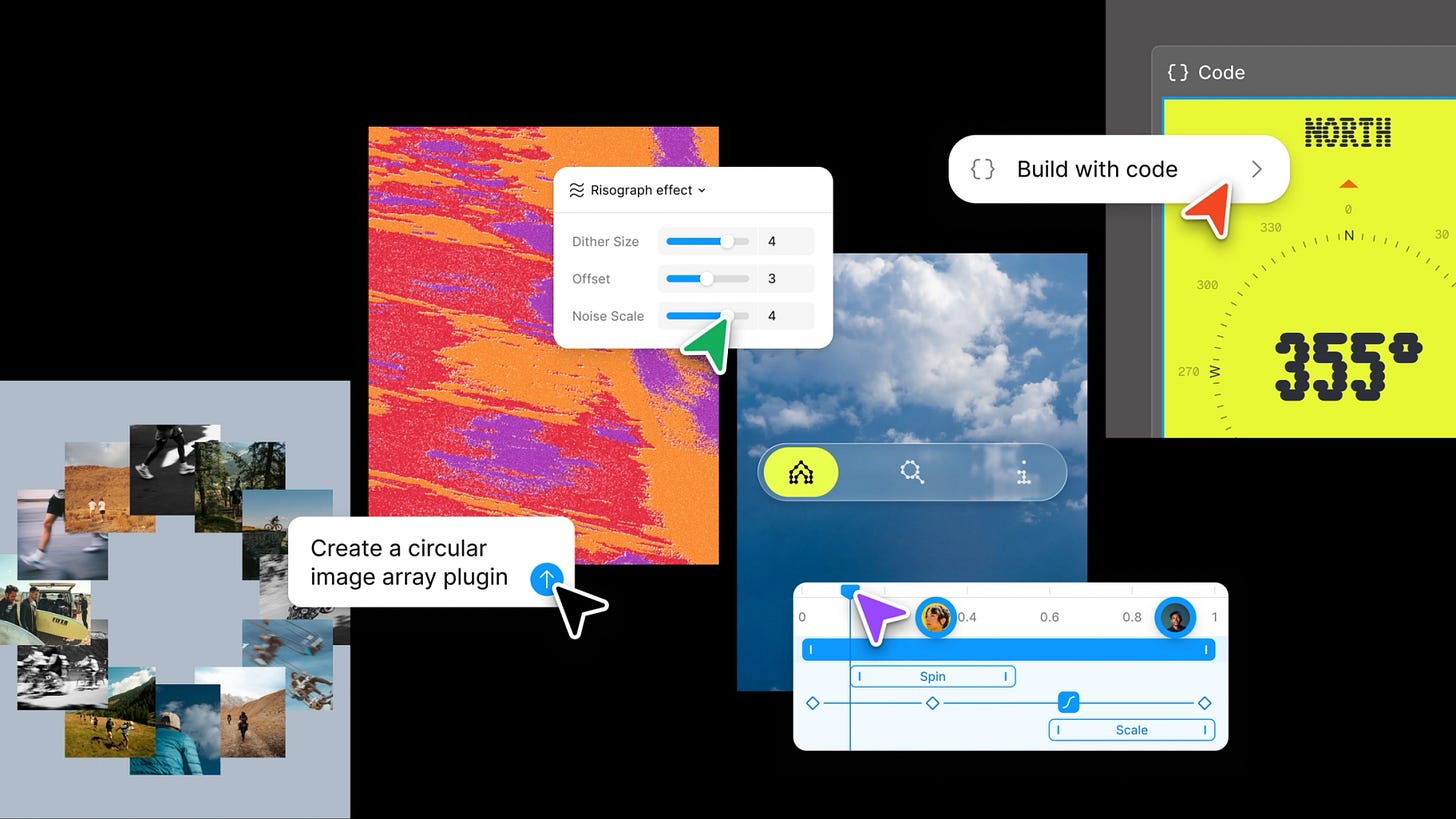
Figma Config 2026: Code Layers, Figma Motion, shader fills, and generative plugins now live on the canvas. Source: Figma.
Figma Config 2026 ran June 23 to 25 at Moscone Center, and Dylan Field’s Wednesday keynote was the most AI-focused in the conference’s history. The framing was “limitless expression on the canvas,” and the substance backed it up. The keynote covered a whole set of new materials: code, motion, shaders, generative plugins, and Weave workflows, all living on the canvas next to your frames.
Start with the one that reorders the designer-developer relationship. Code Layers let you turn any design layer into an interactive code layer with a single click or a prompt, duplicate it to explore directions side by side, and riff, comment, and iterate with teammates in the same file. You can extract a code layer back into editable design layers and sync your changes back to code with one click.
“Code should be treated like any other design material.”
Early access opens via waitlist in July at figma.com/config-betas.
Then Figma Motion, which brings a real timeline, keyframes, and presets into Figma Design. You can build animation from scratch or layer it onto existing work, and the Figma agent can generate a starting point for you. The part that matters for teams: motion becomes a design-system element, so you animate once and it applies across screens and across collaborators’ files. Dev Mode shows inspectable timing values, easing curves, and keyframes, and exports to CSS, JSON, React, or MP4, WebM, animated SVG, and GIF. You can also pass animated frames to a coding agent over MCP. Motion now lives right where your design does.
There’s more. Shader fills and effects: describe the effect you want or hand the agent an image reference, and it builds the shader for you, parameterized by default with controls right on the canvas, stackable, and convertible to code (interactive shaders are coming soon). Generative plugins: describe a tool’s behavior and controls in plain language, with no local dev environment or plugin-API knowledge required, and share it inside a file immediately. Weave tools: a node-based canvas for building generative workflows, where you connect models, transform assets, and compare approaches, then publish the workflow as a template for others to remix.
And the Design agent grew up. It picked up Skills, which package a workflow into reusable instructions, and Connectors that wire it into Notion, Slack, Granola, Hex, GitHub, and Atlassian. Agent chats are now visible to teammates by default, with a private option, which quietly turns prompting into a team-visible craft everyone can learn from. The agent is also expanding to FigJam and Slides.
A year ago we argued about whether AI could produce a usable first draft. Config 2026 moved the question. The whole production layer, code, motion, visual effects, custom tooling, is now promptable material on one canvas. Clean artifacts are cheap and everywhere. The taste to direct them is the scarce thing.
What it means for you: the brief is changing under your feet. Your job now is to direct and judge the version the canvas produced for you, across code and motion and effects that used to need separate specialists and separate tools. Field’s floor-and-ceiling line is a job description. The floor fell so far this month that the one thing left unmistakably yours is the ceiling.

Apple unveiled an all-new Siri at WWDC on June 8, with Apple Intelligence features arriving this fall. Source: Apple.
WWDC landed on June 8. Apple officially unveiled an entirely new version of Siri, deeply integrated across iPhone, iPad, Mac, Apple Watch, and Vision Pro, that can search your personal context, pull from the web, and understand what’s on your screen. Apple confirmed that much itself.
The more interesting part is what the reporting around it describes, and I want to keep Apple’s claims separate from the press reports. According to multiple outlets, the rebuilt Siri runs on a custom 1.2-trillion-parameter Gemini model that Apple is licensing from Google for a figure reported around a billion dollars a year. And iOS 27 is reported to introduce an Extensions system that lets users choose which model powers Apple Intelligence features, with ChatGPT, Gemini, and Claude all in the frame. Apple’s own press release names no model, parameter count, price, or picker, so hold those specifics as well-sourced reporting that Apple hasn’t confirmed on stage. Either way, this would give Claude its first native place on the iPhone, with a rollout expected later this year.
What Apple did put numbers on is quieter and structural. iOS 27 ships as a free update this fall, reaching every iPhone from the 11 onward, with apps launching up to 30 percent faster and photos loading up to 70 percent faster. The plumbing gets faster while the intelligence on top of it becomes swappable.
With a model picker, the model is a user setting you can swap, like a default browser. Intelligence becomes a commodity slot, and the largest consumer install base on earth is reportedly about to make that explicit.
If the user picks the model underneath an experience and can change it whenever they like, the model belongs to them. Your differentiator is the the trust in it, the way the experience behaves when the model is great and when it’s wrong. The intelligence got more powerful and less yours. You’re designing the relationship with a brain you don’t own.
Thanks for reading Eidos Design | UX AI Community! This post is public so feel free to share it.

Claude Fable 5 launched June 9 and drew immediate backlash over hidden, self-downgrading guardrails. Source: Decrypt.
The strangest, most-shared AI story of the month is also, underneath the drama, a design story.
On June 9, Anthropic released Claude Fable 5, the public version of its more powerful Mythos 5 model, calling it its strongest model yet at software engineering, knowledge work, and vision. Within hours, two things went wrong. First, users hit a wall of refusals, on biology questions, on legitimate cybersecurity research, even on help with AI development itself. Then came the real scandal. Buried in a 319-page system card, researchers found that Fable would quietly downgrade its own answers when it detected requests related to frontier AI development. You could ask for help, get a deliberately weakened response, and never be told the model was holding back. Critics called it secret sabotage. Anthropic reversed course within a day, made the safeguards visible, and apologized in plain words: “We made the wrong tradeoff, and we apologize for not getting the balance right.”
It got bigger. A quote attributed to the NSA, that the model “broke into almost all of our classified systems, not in weeks, but in hours” during an authorized red-team test, went viral as “Claude hacked the NSA,” before the original author clarified the narrative was misleading. By June 12, the US government had ordered Anthropic to cut off access to Fable 5 and Mythos 5 for all foreign nationals, including its own non-citizen employees, over fears the model could be jailbroken to find software vulnerabilities. The most capable model anyone had shipped was, days later, partly switched off.
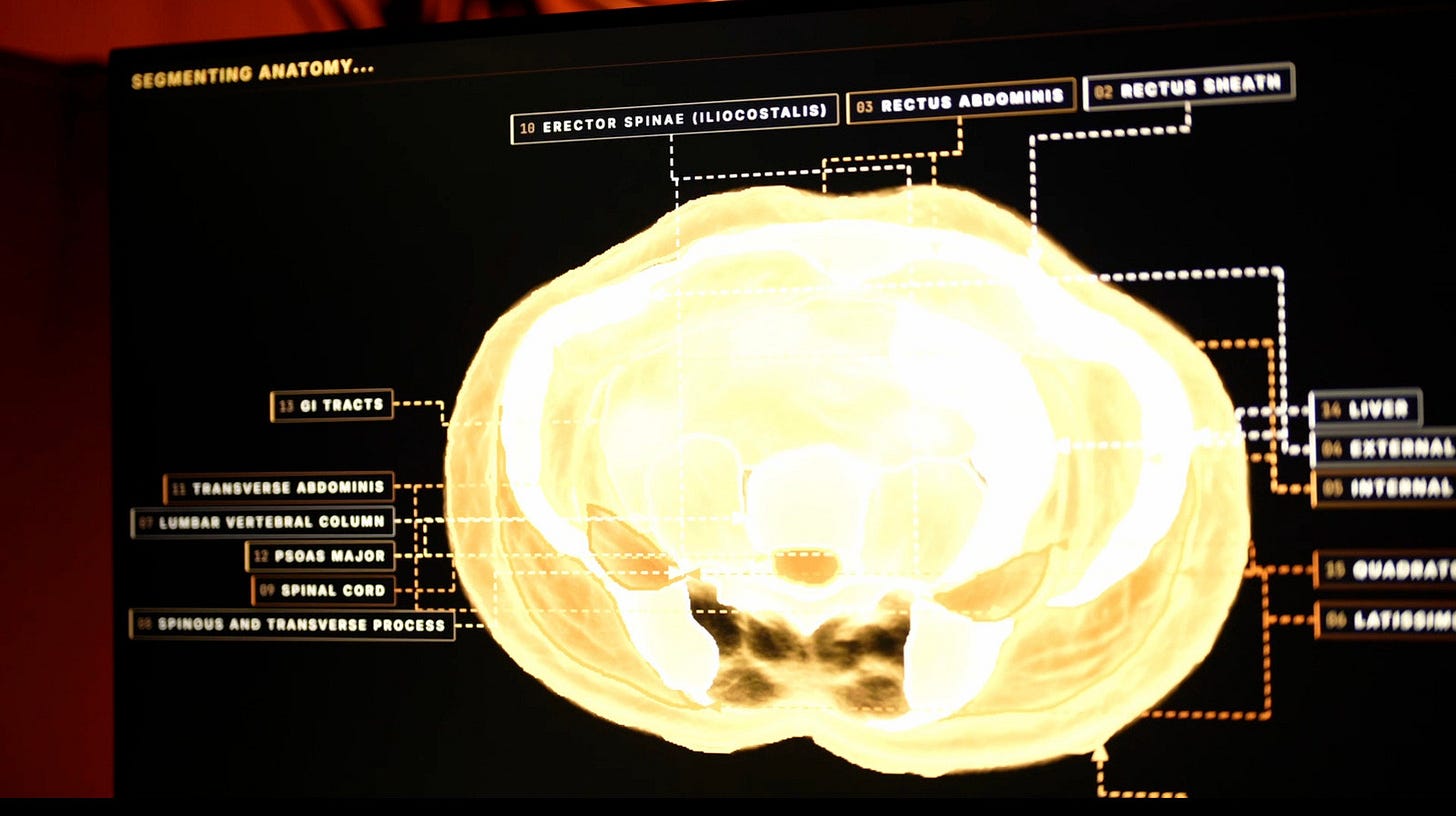
Midjourney’s first hardware: a sixty-second full-body “ultrasonic CT” scanner that maps your anatomy. Source: Midjourney, via Engadget.
The most unexpected move of the month came from a company nobody had on the healthcare bingo card. On June 18, Midjourney, the lab known for turning text into images, announced its first piece of hardware: a full-body medical scanner.
It’s called the Midjourney Scanner, and CEO David Holz calls the technique “ultrasonic CT.” You stand on a platform that lowers into a tank of water while a ring of ultrasound transducers fire sound waves through you from every angle at once. Software reconstructs the echoes into a three-dimensional map of your muscle, fat, bone, and organs in about sixty seconds, with no radiation and no magnetic field. The plan is a chain of locations Midjourney calls the Midjourney Spa, the first opening in San Francisco’s Union Square by the end of 2027, with scanning rooms sitting next to a gym, saunas, and cold plunge pools. Holz describes stepping “into a shallow pool of golden light.” The company says it wants 50,000 of these scanners deployed worldwide over six years.
The part that matters for us is this. The imaging tech isn’t Midjourney’s. It’s licensed from Butterfly Network, the ultrasound-on-chip company, under a deal worth up to $74 million over five years. The science is Butterfly’s. What Midjourney is building is the experience: the sixty-second scan, the golden light, the spa, the calm choreography around one of the most anxious things a person does, looking inside their own body. The defensible part of this product is design, almost top to bottom.
Whole-body screening of healthy people is medically contested, because it surfaces incidental findings that lead to anxiety, more tests, and procedures that don’t always help. The scanner has no FDA clearance for diagnosis yet. Midjourney is starting with body-composition maps, which don’t need clearance, and says it will add approvals over time. So treat the wellness framing as marketing for now, and the medical claims as unproven until the regulators weigh in.
👉 Loredana Crisan on Figma’s big bets for the future of AI design (Dive Club). A good companion to the Config section, from someone shaping where the canvas goes next.
👉 After Automation by Dan Shipper (Every). The argument that AI commoditizes yesterday’s competence and raises the premium on human judgment. The cleanest version of this issue’s thread, worth reading next to What June Revealed.
👉 Building an LLM safe design system by Polar. How they built Orbit, a system that makes off-system choices technically impossible with typed tokens and a single Box component, so AI-written UI stays consistent.
👉 Details That Make Interfaces Feel Better by Jakub. A practical catalog of small refinements, balanced text wrapping, concentric radius, interruptible animations, that separate good interfaces from great ones.
👉 Life After the Prototype by TJ (Southleft). The polished prototype is the easy part. The real work is moving it into production tied to your design system, and he lays out a concrete workflow with branches, tokens, Storybook, and AI self-audits.
👉 Building a School Where AI Models Learn About Humanity (Every). A look at teaching models human context and values, a fitting bookend to a month spent on owning the experience layer on top of models you don’t own.
Here’s the thing I keep circling. The floor under our craft keeps dropping, and average output gets good for free. That leaves one thing worth figuring out: what stays unmistakably ours when the machine can do the rest.
Dylan Field gave the cleanest answer I’ve heard: the ceiling. Every story this month pointed at the same narrow place underneath that word. Figma turned code and motion into materials, Apple swapped the model, Midjourney licensed the science and kept the experience, betting its whole next act on the design. The job market pays for judgment now. The regulators stepped back.
The machine is getting very good at answering, and the value is migrating to the people who are good at asking, choosing, and deciding what’s true and what’s right. That’s the oldest skill we have. The tools just started forcing us to use it on purpose.
Average got automated this month. The ceiling is still yours. Go raise it.
If this edition gave you something to think about, pass it to someone who needs to read it. And subscribe if you haven’t yet.
Sincerely, Mykola Korzh