Hello fellow designers, creatives, digital professionals, and Eidos Design members!
Mykola here, back with October’s most fascinating news from the intersection of design and technology.
This month gave us the most powerful design tools we’ve ever had, and the most interesting questions about what we’ll build with them.
October was when “AI will augment designers, not replace them” stopped being a prediction and started being something we have to actually do.
The tools caught up. Now comes the interesting part.

Fresh Squeeze: Launches & Makeovers
Figma made a bold move by partnering with both OpenAI and Google just three days apart
On October 6, Figma launched its official integration with ChatGPT. Now, the 800 million monthly users of ChatGPT can create FigJam diagrams simply by mentioning “Figma” in their conversations. Transform text discussions into flowcharts. Transform meeting notes into a visual system map.
The market loved it. Figma’s stock price surged 15% during the day, marking the largest one-day increase since its IPO in July.
Three days later, Figma announced that they are integrating three Google Gemini models: Gemini 2.5 Flash for image editing; Gemini 2.0 for advanced capabilities; and Imagen 4 for image generation. Early testing showed a 50% reduction in latency. It’s fast enough to feel like sketching, not waiting.
The fascinating thing isn’t that Figma added AI features — everyone’s doing that. It’s that they’re betting on becoming platform-agnostic infrastructure. CEO Dylan Field calls this approach “becoming the visual layer of the AI era.”
They aren’t competing with OpenAI or Google. They’re making themselves indispensable to both. They want to be what everyone needs, regardless of which AI platform wins.
Adobe’s Play: Your Brand, Your Model
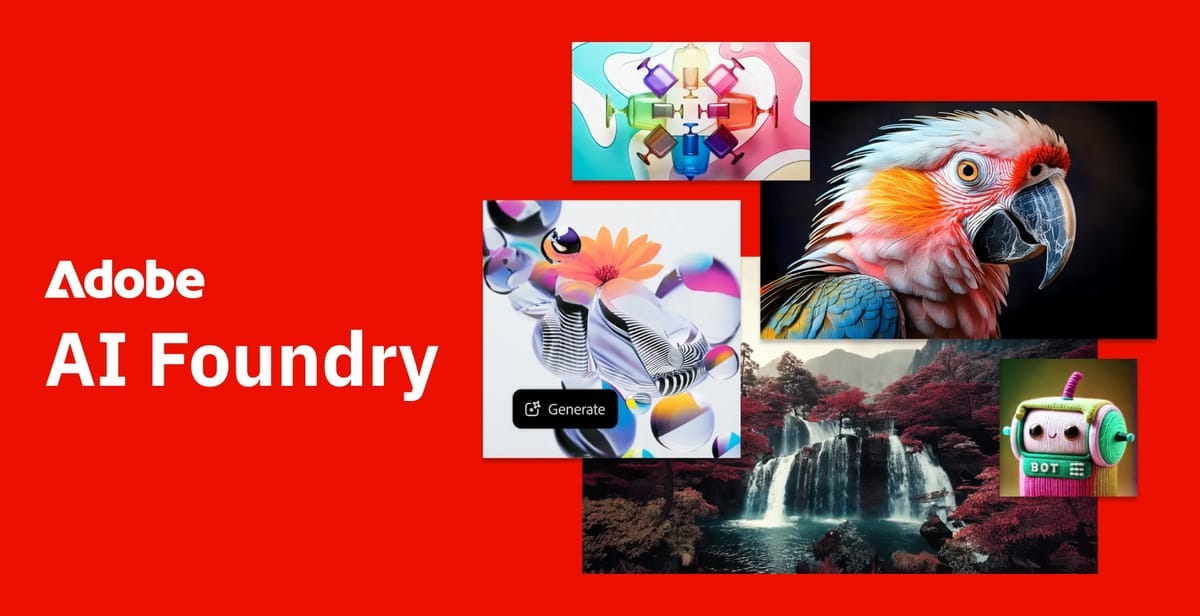
Adobe Announces AI Foundry Promo
On October 20, Adobe launched AI Foundry. They’re surgically reopening their Firefly foundation models and retraining them with your brand’s imagery, videos, shot styles, and intellectual property. They call it “deep tuning” instead of fine-tuning.
The result is a custom generative AI model that doesn’t just know about your brand, it thinks in your brand. Generate images, videos, text, audio, vector graphics, 3D scenes, all inherently on-brand because the brand is baked into the model.
Early customers include Home Depot and Walt Disney Imagineering. Since its launch in 2023, enterprises have used Firefly to create over 25 billion assets.
What makes this interesting is that: Adobe only uses licensed content for training. When you create a custom Firefly model with your brand assets, the outputs are commercially safe. There’s no legal ambiguity or copyright concerns.
For enterprises that have been hesitant to let designers explore generative AI, this removes the biggest barrier.
The broader implication is that brand guidelines are shifting. Rather than maintaining a 200-page brand book that designers must interpret manually, you can train a model that simply recognizes what is on-brand.
Designers move from execution to direction. Less time policing brand consistency, more time figuring out what’s worth building.
UXDesign.cc published their 10th annual State of UX report and announced it’s the last one in this format.
Why? Because the authors concluded that design control has fundamentally transferred “from designers to a complex network of algorithms, automated tools, and business stakeholders.” Designers are navigating new relationships with AI tools. Growth teams optimize for metrics over clarity. Design decisions stem from organizational politics more than user needs.
The report ends with “if you love to design, you’ll find your way,” which could sound like resignation. But I read it differently.
I think they’re saying: the old way of understanding design work doesn’t fit anymore. Stop trying to measure 2025 design against 2015 standards.
The definition of design work is being rewritten in real-time.
Webflow Became a Platform (And Wants Your Whole Stack)
Webflow Conference 2025 Promo
Webflow held their annual conference on October 15-16 and announced they’re now a “Website Experience Platform.” The news: AI code generation creates production-ready web apps from text prompts. Next-generation CMS that can handle over one million items. Real-time collaboration allows multiple people to work on the same page simultaneously. Code components allow developers to import React components directly onto the canvas.
Webflow is coming for your entire development workflow. The ambition is bold, and if they pull it off, the line between “design” and “development” gets even blurrier.
Google Cut 100+ Design Roles
Throughout October, Google laid off more than 100 designers in its cloud division, with the cuts hitting “quantitative user experience research” and “platform design” roles particularly hard.
Google didn’t say “AI is replacing these roles,” but the subtext isn’t subtle. These are exactly the kinds of systematic, data-focused positions where AI shows competency. The transformation is real, and it’s not painless.
Perplexity Acquired Visual Electric
On October 1, Perplexity acquired the team behind Visual Electric, a Sequoia-backed AI design startup. Visual Electric will shut down as a standalone product within 90 days. Another specialized tool gets absorbed by a larger platform. The ecosystem is consolidating fast.
**AI tools in 2025 make portfolio procrastination harder to justify. While AI won’t create a portfolio for you, it removes barriers by: speeding up drafting, reducing overwhelm, allowing you to focus on editing and quality.
Caution: AI alone won’t make your portfolio unique or meaningful. Your input, refinement, and personal style are crucial. But yes, AI can help.
How to become a design engineer, ft. Karl Koch
The role of a design engineer is emerging in tech, especially for complex products. Success comes from a mix of curiosity, practical coding, design skills, and proactively building and sharing your work.
**Everyone should be using Claude Code more **In this article, Lenny Rachitsky discusses Claude Code, an underrated AI tool that is particularly useful for non-technical individuals. He explains how Claude Code works locally on your computer — making it fast and capable of handling large files and longer tasks. And he offers a step-by-step guide to installing and launching it, then showcases 50 creative, real-world ways people are using Claude Code in daily life and work
7-practical-animation-tips by Emil Kowalski offers actionable advice for improving UI animations, even if you’re not a natural animator. Kowalski emphasizes that great animation is about intentional details and that there’s no hidden magic. He provides CSS snippets and practical visuals for each tip and encourages further learning through his online course.
Rooz Mahdavian - Designing frontier interfaces at Neuralink and Apple
Rooz Mahdavian, a design engineer at Neuralink and former member of the Apple Watch Faces team, discusses his experience designing cutting-edge user interfaces, from smartwatch faces to brain-computer interfaces (BCIs). The talk blends design philosophy, technical challenge, and ethical implications, making it a must-listen for those interested in the evolution from screen-based to mind-driven interfaces and the rigorous craft needed to make such radical technologies usable and delightful.
What Happens Next
October gave us clarity. The tools are here. AI-powered design capabilities that seemed impossible two years ago are now baseline features.
Some roles are indeed being eliminated. Companies are restructuring around these new capabilities.
But here’s what I keep coming back to: What about the design work that’s being automated? Most of us didn’t love it anyway. The 47th button variation? Manually checking brand compliance across 200 screens? Surveys that could have been A/B tests.
The work that actually requires human judgment remains. This includes knowing what’s worth building and why. It’s about understanding users at a level that algorithms can’t reach. It means directing AI systems toward valuable outcomes instead of just impressive outputs.
This is design work finally matching what we said design was supposed to be all along: strategic, human-centered, focused on impact over execution.
The uncomfortable part? Getting there requires learning new skills faster than our job descriptions change. Being the person who knows how to use AI as a force multiplier. Leveling up strategic thinking while machines handle execution.
Now comes the interesting part: what will we build when execution isn’t the bottleneck?
I’m genuinely excited to find out.
If this edition sparked something for you, share it with someone who needs to read it. And subscribe if you haven’t already. November’s going to be wild.
Sincerely,
Mykola Korzh