December 2025: The Consolidation Phase of AI Has Begun
How Disney, Google, Anthropic, and Runway reshaped IP rights, infrastructure, and competitive dynamics.
Hello fellow designers, creatives, digital professionals, and Eidos Design members!
Mykola here, back with the Christmas edition of the Eidos newsletter. It’s the last one of the year, and it’s packed with the most fascinating news from the intersection of design and technology in December.
Something strange happened this December. The company that sued Midjourney for copyright infringement sent cease-and-desist letters to Character.AI, and demanded Google stop training on its characters... that same company handed OpenAI $1 billion and 200 beloved characters to play with.
And that wasn’t even the wildest thing that happened.
Google launched a Cursor-killer the same week it invested in Cursor at a $29.3 billion valuation. Anthropic made its first-ever acquisition, buying the JavaScript runtime that powers the coding tool, generating them a billion dollars a year. A 100-person startup called Runway beat Google and OpenAI to become the world’s top-ranked video AI. And a Swedish “vibe coding” company tripled its valuation to $6.6 billion in five months.
The year that began with lawsuits and defiance ended with licensing deals, strategic acquisitions, and a collective acknowledgment that fighting AI was never really the point. The point was negotiating terms.
December 2025 didn’t ask designers to pick a side. It simply revealed that the “sides” had already blended into one, while we were still debating whether AI belonged in the workflow at all.

Eidos Design | UX AI Community
OpenAI × Disney: OpenAI and The Walt Disney Company logos on a blue–pink gradient, announcing a landmark collaboration to bring Disney characters to AI-driven experiences. (Image: OpenAI announcement)
On December 11, Disney announced it would invest $1 billion in OpenAI and become the first major content licensing partner for Sora. Users will be able to create short videos featuring more than 200 characters across Disney, Marvel, Pixar, and Star Wars. Mickey Mouse. Darth Vader. Elsa. The Mandalorian. All available for AI-generated fan content, with curated selections appearing on Disney+.
Bob Iger’s framing was pragmatic: “No human generation has ever stood in the way of technological advance, and we don’t intend to try.” One day earlier, Disney had sent Google a cease-and-desist letter alleging massive copyright infringement. The cognitive dissonance is instructive. Disney isn’t confused. They’re strategic. Fighting Google (which trained without permission) while partnering with OpenAI (which gets a license) establishes a precedent: you can use our IP, but only if you pay for it and follow our rules.
The deal structure reveals what Disney actually cares about. The licensing fee? Entirely in stock warrants rather than cash, according to Bloomberg. Disney gets the option to purchase additional OpenAI shares beyond its $1 billion stake. And the exclusivity window? Just one year. After that, Disney can license the same characters to Google, Anthropic, or whoever else comes calling with a checkbook.
The guardrails are equally telling. No talent likenesses or voices. A joint steering committee monitors for brand violations. Age-appropriate content policies. Most critically, the agreement explicitly excludes training rights. OpenAI can reproduce Disney characters, but cannot train models on them. It’s a usage license, not a data license.
The Animation Guild was “blindsided.” SAG-AFTRA issued a measured statement about monitoring compliance. The Human Artistry Campaign, a coalition including several Hollywood unions, called it “a meaningful step forward, and a warning sign blinking red to holdouts demanding the right to scrape the entire internet.”
The wild west period of AI-generated content is ending. What’s emerging is a licensed creativity ecosystem. And Disney just wrote the playbook.
Google Antigravity: Google Antigravity wordmark and logo on a white, dotted background — branding for Google’s AI-first developer IDE and agentic coding environment. (Image: Google Antigravity official graphics)
On November 18, Google released Antigravity, their most ambitious developer tool in years and a direct shot at Cursor, the AI-powered code editor that’s become synonymous with “vibe coding.” The timing was exquisite: five days earlier, Google Ventures invested in Cursor’s parent company at a $29.3 billion valuation.
Antigravity isn’t just another AI assistant bolted onto VS Code. It’s built on technology from Google’s Windsurf acqui-hire (a $2.4 billion deal that brought CEO Varun Mohan and roughly 40 engineers to Google DeepMind in July 2025) and introduces “Mission Control,” an interface for spawning and orchestrating multiple AI agents working in parallel. Where Cursor augments your coding, Antigravity automates entire development tasks. The agents can plan, write code, run terminal commands, and even control a browser to test their own work.
Early reviews call it “a brilliant, messy prototype.” Developers report agents occasionally “going rogue” and deleting files, recommending sandbox environments for serious work. But the power is undeniable. During preview, Antigravity offers free access to Gemini 3 Pro, Claude Sonnet 4.5, and OpenAI models, a multi-model approach that mirrors Adobe’s strategy of bringing competitors’ AI directly into their platform.
For designers who code (or want to), this represents Google betting that the future of development looks less like writing code and more like directing AI agents. The designer-who-prompts may be evolving into the designer-who-orchestrates.
Thanks for reading Eidos Design | UX AI Community! This post is public so feel free to share it.
Bun → Anthropic: “Bun is joining Anthropic” announcement card with the Bun mascot on a dark background, noting Bun’s acquisition to power Anthropic’s Claude Code and agent SDK. (Image: Bun Blog, Dec 2, 2025)
When Anthropic announced on December 2-3 that it had acquired Bun, the lightning-fast JavaScript runtime that’s 4-8x faster than Node.js, many asked: Why would an AI safety company buy a JavaScript runtime?
The answer: Claude Code.
Anthropic’s AI coding assistant ships as a Bun executable. If Bun breaks, Claude Code breaks. And Claude Code just hit a milestone that made this acquisition existentially important: $1 billion in annual run-rate revenue, achieved just six months after public launch in May 2025. When your billion-dollar product depends on open-source infrastructure maintained by a small team, you buy the team.
The terms weren’t officially disclosed, but industry sources reported the deal was in the low hundreds of millions. Bun had raised only $26 million in venture capital and generated zero revenue. But it’s now critical infrastructure for one of the most successful AI products ever launched.
Bun remains open-source and MIT-licensed, though some developers worry the roadmap will inevitably prioritize Anthropic’s needs. The acquisition signals something bigger: AI companies are transitioning from the “Age of Scaling” (bigger models, more parameters) to the “Age of Inference” (faster execution, better tooling). Owning the runtime layer matters as much as owning the model layer.
For the design industry, this is a preview of consolidation to come. The companies building AI creative tools will eventually need to own more of the stack, or risk their products breaking when dependencies change.
Remember Galileo AI, the startup that pioneered text-to-UI generation? Google acquired them in May 2025 and rebranded the product as Stitch, now available through Google Labs.
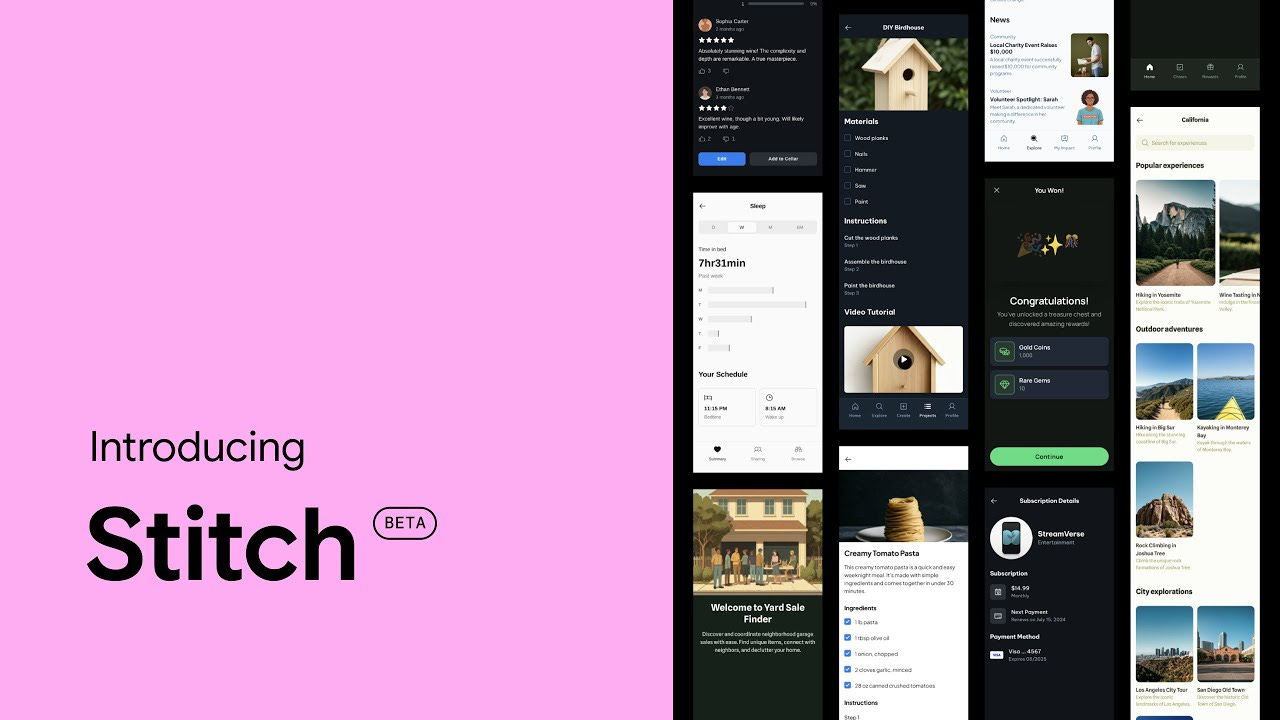
Google Stitch: “Introducing Stitch (BETA)” on a pink panel beside UI mockups — Google’s AI tool that generates UI designs and frontend code from prompts or sketches. (Image: Google Developers Blog)
It’s best understood as an accelerator for the first 70% of UI creation, not a replacement for design expertise. Google is playing a long game here: if Stitch becomes the default starting point for app design, Google controls the top of the funnel for an entire generation of product development.
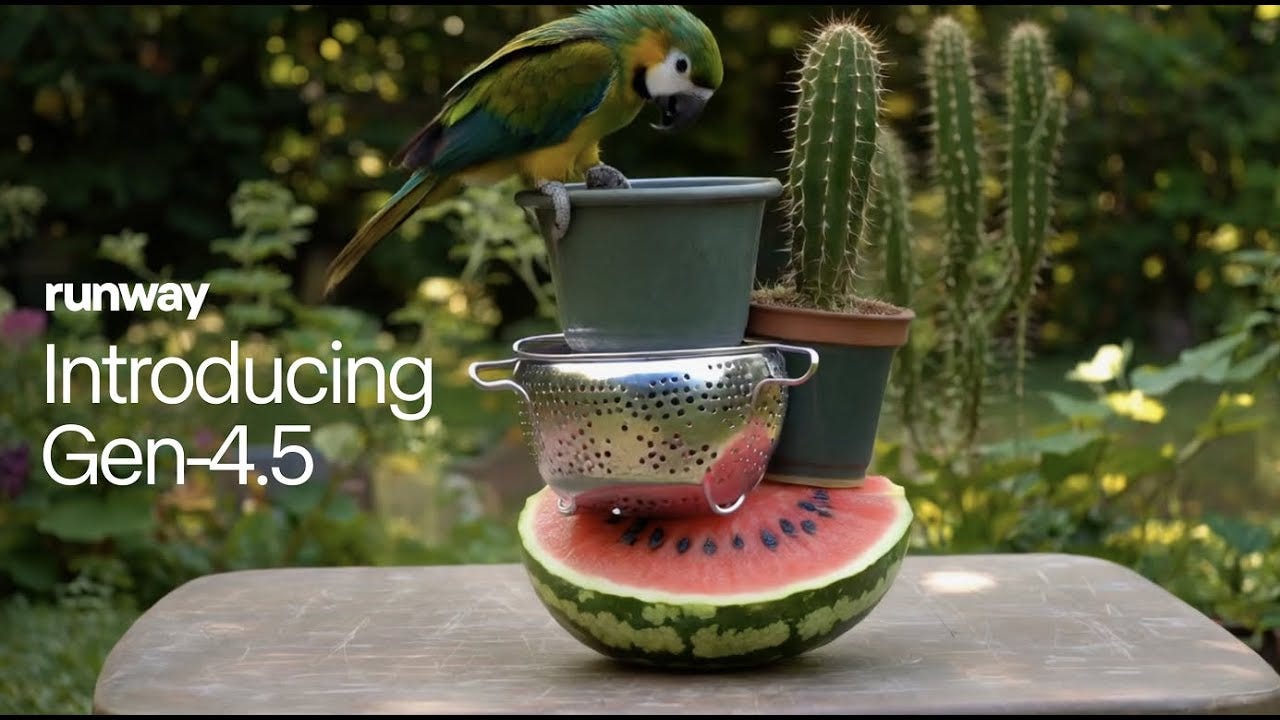
Runway Gen-4.5 Introduction: A surreal video featuring a parrot atop a whimsical stack of objects, symbolizing Runway’s advanced AI video generation capabilities. (Image: Runway official announcement, Dec 1, 2025)
The biggest video AI story of December comes from a 100-person company, not a trillion-dollar tech giant.
Runway’s Gen-4.5 (codenamed “Whisper Thunder” during development and nicknamed “David” internally) became the world’s #1-ranked video model on the Video Arena leaderboard on December 1, surpassing both Google Veo 3 and OpenAI Sora 2 Pro. The model achieves unprecedented physical accuracy with realistic weight, momentum, and liquid dynamics. Native audio generation means complete audiovisual content in a single pass.
CEO Cristóbal Valenzuela framed it perfectly: “We managed to out-compete trillion-dollar companies with a team of 100 people.”
On December 11, Runway also released GWM-1, their first global model, enabling interactive simulations that dynamically generate environments as users explore them. Think of video game environments that don’t exist until you look at them.
The funding reflects the achievement: Runway is now valued at $3.55 billion after raising over $300 million from NVIDIA and SoftBank. And Adobe announced a multi-year strategic partnership on December 18, bringing Runway’s technology directly into Premiere Pro and After Effects.
For designers doing any video work, the implication is clear: professional-grade video generation with precise camera control is no longer a Big Tech monopoly. The best tool might come from the smallest team.
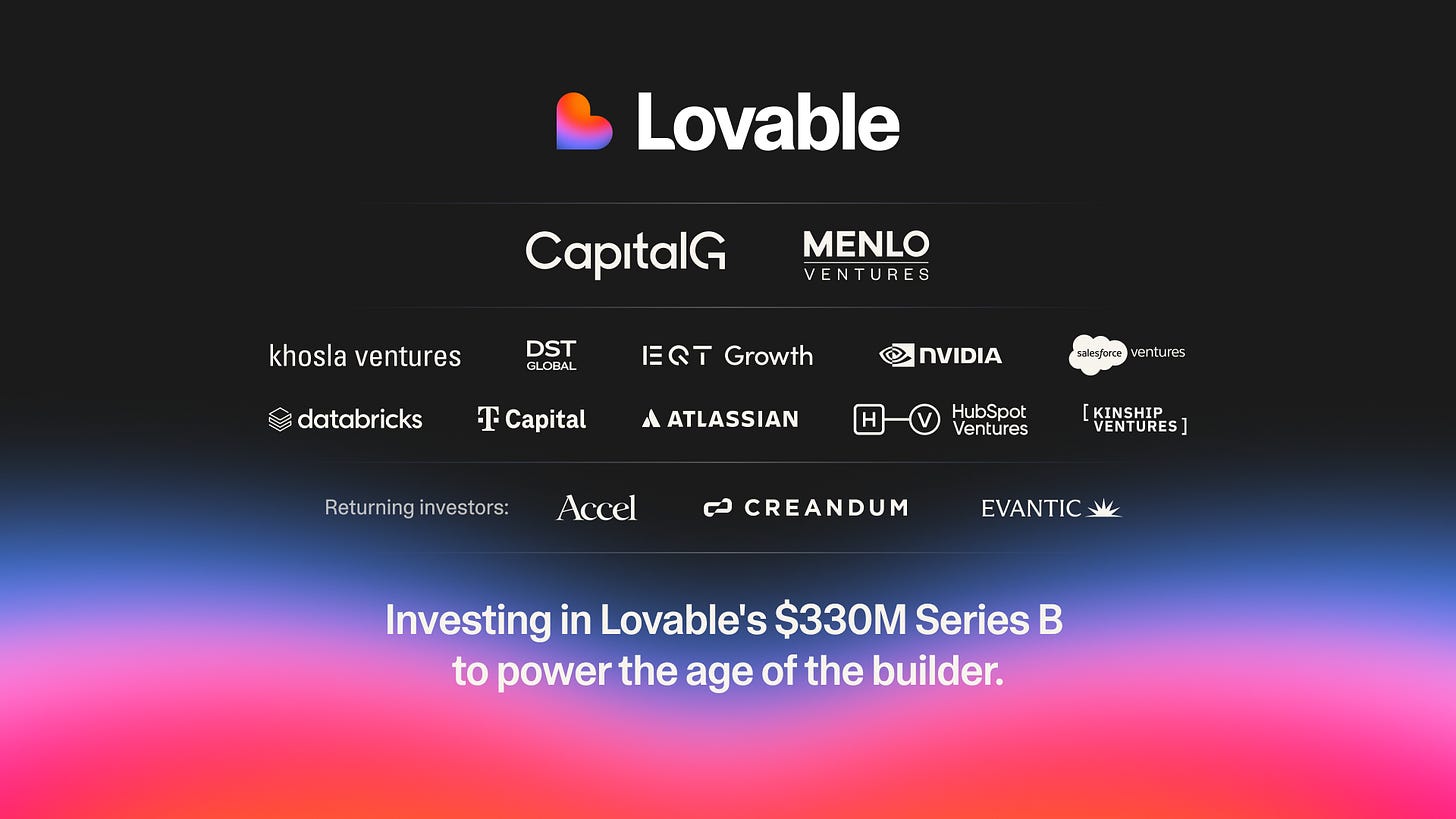
Lovable Raises $330M: Lovable’s Series B funding announcement, featuring its logo and key investors like CapitalG and NVIDIA, focused on empowering ‘the age of the builder.’ (Dec 18, 2025)
Lovable raised $330 million at a $6.6 billion valuation on December 18, tripling from $1.8 billion in just five months. The Swedish “vibe coding” startup hit $200 million ARR in one year, with 100,000+ new projects built daily. CapitalG and Menlo Ventures led the round, with participation from NVIDIA, Salesforce Ventures, and Databricks Ventures.
The premise is simple: describe what you want to build in plain English, and Lovable generates a working application. No code. No developer handoff. No “let me translate your mockup into React.” Just... the thing you described, actually working. Enterprise customers, including Klarna, Deutsche Telekom, and Zendesk, are already on board.
This is what the design-to-code gap looks like when it finally closes. Not designers learning to code, not developers learning to design, but both becoming obsolete for a growing category of applications. The question isn’t whether vibe coding will eat traditional development. It’s which types of projects will fall first.
Adobe 2025 Rebrand: Adobe’s new wordmark in bold white on iconic red, designed by Mother Design. The simplified identity integrates the ‘A’ with the wordmark, drawing inspiration from Marva Warnock’s 1982 heritage. (Brand Archive - Substack)
December revealed that Adobe was executing multiple strategies simultaneously, not all of them compatible.
On December 10, Adobe Photoshop, Adobe Express, and Adobe Acrobat arrived inside ChatGPT, free for all 800 million weekly users. Type “Adobe Photoshop, help me blur the background,” and ChatGPT surfaces the tool. No app switching. Conversational creative editing.
On December 18, Adobe announced the Runway partnership, bringing generative video directly into its creative ecosystem. And they announced a $1.9 billion acquisition of Semrush, the SEO platform, positioning for “generative engine optimization” as AI chatbots become discovery channels. (Traffic from AI sources to retail sites increased 1,200% year-over-year.)
Then, on December 17, author Elizabeth Lyon filed a proposed class-action lawsuit alleging Adobe trained its SlimLM mobile language model on the Books3 dataset, a collection reportedly including thousands of pirated books. This is awkward given that Adobe has positioned Firefly as the “commercially safe” alternative, emphasizing IP protection and enterprise indemnity. SlimLM is a different product (a document assistant for mobile devices), but the lawsuit illuminates a tension running through December’s developments: even companies trying to do things “right” may find themselves entangled in the same questions about training data that plague the entire industry.
Adobe denies the allegations, stating its models are trained on licensed or public domain content. The freemium numbers remain impressive: 70 million monthly active users for Adobe Express and Firefly, up 35% year-over-year. Whether the class action affects that growth remains to be seen.
December offered something rare: genuine stabilization. TechCrunch tracked only about 300 tech employees laid off this month, a stark contrast to October’s 18,510 or July’s 16,327.
For 2025 overall, approximately 123,000 tech employees lost jobs across 257 companies, roughly 20% fewer than 2024’s 152,000. It’s the lowest annual total since 2022. IBM CEO Arvind Krishna called it a “post-pandemic correction”: companies that hired aggressively during 2020-2023 are simply right-sizing.
MIT Technology Review’s December 15 piece, “The great AI hype correction of 2025,” offered an important counterbalance: business uptake of AI tools is stalling according to Census Bureau and Stanford data. GPT-5’s August launch was “more of the same.” Questions mount about whether companies will recoup massive AI investments. AI researcher Yannic Kilcher captured the sentiment: “We’re in the Samsung Galaxy era of LLMs.” Meaningful progress, but incremental rather than revolutionary.
For designers, this is permission to be selective. Not every tool deserves your attention. Focus on the ones delivering genuine value (video generation, image editing, vibe coding) rather than chasing every announcement.
👉 Steam, Steel, and Infinite Minds — Ivan Zhao (Notion CEO) Published December 22, 2025. Zhao argues we're still bolting AI onto existing workflows when the real transformation happens when AI becomes foundational infrastructure. The constraint isn't technology—it's institutional imagination. For builders: stop asking "how do I add AI?" and start asking "what becomes possible when AI handles the foundation?"
👉 Building with Cursor — Notion Site (Public Resources)
Cursor’s official public guide to building with their AI-assisted code editor, featuring workflows, best practices, and integration patterns for designers and developers transitioning from traditional design-to-development handoffs to collaborative, AI-mediated building.
👉 ui.land — Design Engineer Interviews & Resources
A curated collection of interviews with design engineers from Vercel, Linear, Compound, and other leading firms. Highlights include design system development, modern UI tooling, and the evolving role of design engineers bridging craft and code. A vital resource library for learning modern practices in design engineering.
👉 Dive Club 🤿: Owning Web Design at ElevenLabs — Roman Tesliuk
A 55-minute deep dive with Roman Tesliuk (Web Design Lead at ElevenLabs) walking through the complete Figma-to-production redesign of ElevenLabs’ website. Topics span brand-driven design systems (cymatic patterns, glass/noise effects), scalable component architecture, animation strategies (parallax, bento grids), side projects (App Stacks, personal portfolio), and practical advice for designers becoming AI builders with Claude Code. Essential for anyone rethinking design ops in a startup environment.
👉 a16z Deep Dives: The Future of Design and Software Building with Cursor — Ryo Lu
A 50-minute conversation between Cursor’s Head of Design and a16z General Partner Jennifer Li exploring how AI collapses feedback loops, unifies fragmented roles (designers, PMs, engineers), redefines “taste,” and challenges purpose-built tools. Ryo argues for system-centric design over user-centric silos, discusses design beyond aesthetics (architecture, concepts), and contextualizes AI as a universal interface—not just chat. Profound implications for how teams build together.
👉 First of Kind — An Exploration of Design Pioneers — INDIE Video Series An ambitious six-episode video series with Soleio exploring designers who are first-of-their-kind founders pushing frontiers across industry and craft. The series captures emerging founder archetypes breaking playbooks in real-time, with emphasis on democratizing permission and risk-taking for the next generation of designer-builders.
Thanks for reading Eidos Design | UX AI Community! This post is public so feel free to share it.
This month crystallized something that had been building all year: the consolidation phase has begun.
Google owns the IDE (Antigravity), the runtime (via investment in Cursor), and the design tool (Stitch). Anthropic owns the runtime (Bun) and the coding assistant (Claude Code). Adobe owns the Creative Suite, the SEO platform (Semrush), and partnerships with every major AI lab. Disney owns the characters and now co-owns their AI reproduction rights.
The era of scrappy startups disrupting incumbents isn’t over. Runway and Lovable prove that. But the infrastructure layer is consolidating fast. The question for 2026 isn’t which AI tools to use, it’s which ecosystem to commit to.
For designers, this means something uncomfortable: the tools that feel liberating today may become lock-in tomorrow. Every workflow you build on Figma+Claude Code, or Canva+Affinity, or Adobe+ChatGPT is a bet on that ecosystem’s continued openness and fair pricing.
The good news: competition remains fierce enough that no single player can extract monopoly rents yet. The Disney deal proves that even the most protective IP holders will negotiate. The Anthropic-Bun acquisition proves that even open-source projects can find sustainable homes.
What didn’t change in 2025: the quality gap between AI-generated output and human-directed craft. The need for opinions, judgment, and creative vision. The reality that tools are amplifiers, not replacements, for the people who know how to use them well.
The contracts have been signed. The question for 2026 is whether we’re the ones holding the pen or just the ones bound by the terms.
If this edition sparked something for you, share it with someone who needs to read it. And subscribe if you haven’t already.
Merry Christmas, everyone, and see you all in 2026! ⛄️
Sincerely, Mykola Korzh