April 2026: When the AI Labs Stopped Renting Shelf Space
Mike Krieger left Figma’s board on a Thursday. Claude Design shipped three days later. The labs are no longer renting shelf space.
Hello fellow designers, creatives, digital professionals, and Eidos Design members!
April was literally crazy with news from the tech industry. After the release of the Claude Design, we also decided to take some time and to test it ourselves, as well as to wait what else might happen. That’s why this newsletter lands your inbox a bit later than usual.
Actually, we watched AI labs build on top of design and productivity platforms for the last three years. But April 2026 was the month that the arrangement stopped working, and the stress fractures showed up in the layers above and below it, too.
In a single month, an AI lab CPO left a design platform’s board and shipped a competing product three days later. Around 20,000 tech layoffs occurred in one week, with AI cited as the leading stated reason for the first time in Challenger's history. The vibe coding stack got publicly audited by its own bug bounty. Cursor’s $50 billion round included a structurally unusual SpaceX option. And Apple promoted the person who’s going to ship the platform after the screen.
These stories don’t share a villain. They share a calendar.

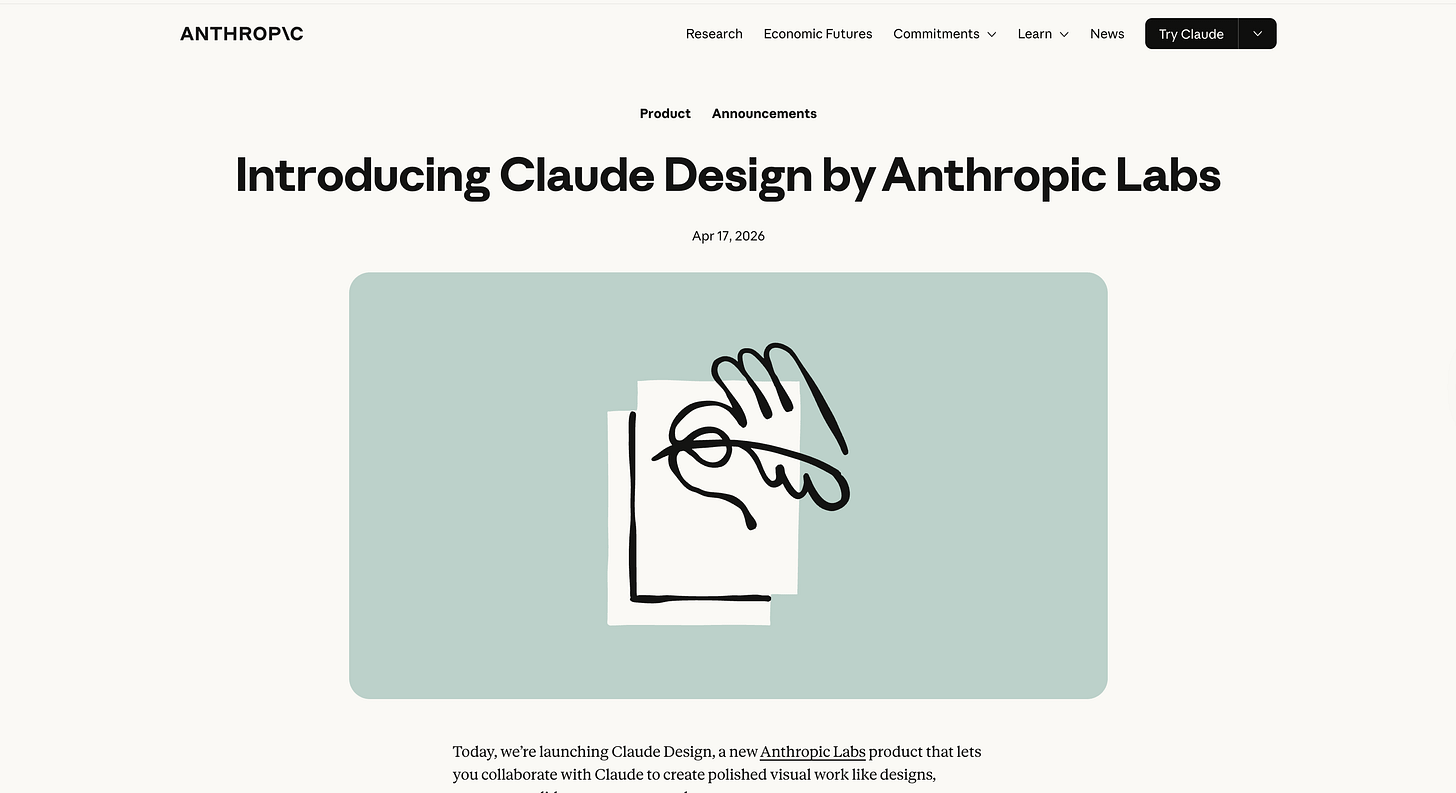
Anthropic shipped Claude Design three days after Mike Krieger left Figma's board. The product competes for the first-draft layer of design work. Source: Anthropic.
Anthropic CPO Mike Krieger resigned from Figma’s board on April 14. The 8-K filing said the resignation was “not due to any disagreement.” The Information reported the same day that Anthropic’s coming Opus 4.7 release would include design tools competing directly with Figma. Three days later, Anthropic shipped Claude Design.
The product is what it sounds like. Generate prototypes, slides, mockups, and websites from natural language. Read your codebase or design files to apply company design systems automatically. Export to Canva, PDF, PPTX, HTML, or live URLs. Pass structured handoff bundles to Claude Code. Available as a research preview to Pro, Max, Team, and Enterprise tiers.
Anthropic’s framing was that Claude Design is “complementary, not competitive” with existing design tools. But the market disagreed. Figma stock fell roughly 7% on launch day, settling at $18.84 from a prior close of $20.32. The stock hit its all-time low of $16.69 a week later on April 24. Through April it was down more than 55% YTD, and roughly 88% from its post-IPO high of $142.92. Adding to the pressure, Figma’s DEF14A proxy filing on April 22 disclosed CEO Dylan Field’s 2025 compensation at approximately $864 million, driven by stock-price-hurdle RSUs that vested before the crash.
The launch videos and the “Figma killer” takes both got ahead of what’s actually shipping. Claude Design is not yet a credible Figma replacement for production work. Constellation Research VP Liz Miller put it well: “Just as master painters have different brushes they use for different things, you are never going to use Claude for design to create your finished masterpiece.” Early hands-on reports call the outputs “visually interesting” rather than analytically usable on real codebases. The collaborative canvas, the multiplayer cursors, the design system graph that millions of teams already maintain in Figma, none of that is replicated.
What Claude Design does compete for is the first-draft layer. The brief-to-comp loop. The “give me 30 explorations of this landing page” task. The slide deck mocked up in twenty minutes for tomorrow’s stakeholder review. That work used to live in Figma. It now has a credible alternative that costs $20 a month and lives inside the same chat where you do the rest of your thinking.
Figma kept shipping through this. Make kits and attachments on April 2. Figcade Fun Day on April 8. AI administration for Enterprise on April 21. Make pay-as-you-go billing on April 21. Make on iOS and Android on April 22. Config 2026 is confirmed for June 23 to 25 at Moscone with around 10,000 attendees expected. Whatever Figma’s response to Claude Design and Google’s Stitch will be, it lands there. And let’s hope it will be something meaningful, not another “draw” feature.
The first-draft layer is what AI labs are claiming. The collaborative canvas, the design system graph, the institutional knowledge baked into your team’s component library, that’s still yours. The implication isn’t that Figma is dead. It’s that the work that used to anchor your day in Figma (the explorations, the mockups, the quick deliverables) now has a strong substitute that doesn’t open Figma at all.
A single week tells the structural story. April 23: Meta announced 8,000 layoffs (10% of workforce) and closed 6,000 open roles, citing “continued effort to run the company more efficiently and to allow us to offset the other investments we’re making.” Same day, Microsoft announced its first-ever voluntary buyout program in 51 years, eligible to roughly 7% of US staff.
The other side of the same week: Meta’s projected 2026 capex was raised to $125-145 billion at its April 29 earnings call (versus $72 billion in 2025). Combined big tech AI infrastructure spending for 2026 is roughly $700 billion.
Challenger Gray’s April 2 report showed AI cited as the cause of 25% of all March cuts, the first time AI was the leading stated reason in Challenger’s history. AI was 5% of cited reasons in 2025. Ten percent in February. Twenty-five percent in March.
The independent productivity data does not support the narrative. Goldman, NBER, MIT, PwC, and IBM data all converge on the same pattern: most enterprises report no significant AI productivity gain. Marc Andreessen called AI “the silver-bullet excuse.” Sam Altman put it more directly: “There’s some AI washing where people are blaming AI for layoffs that they would otherwise do.”
The most defensible reading: the $700 billion capex commitment is the load-bearing structure. The AI productivity story is the wrapper. Lenny Rachitsky’s analysis of TrueUp data shows roughly 5,700 open designer roles globally, flat since early 2023, while PM and engineering roles have grown since 2024. The hiring market isn’t punishing designers because AI replaced design. It’s punishing them because AI restructured the workflow that design used to occupy.
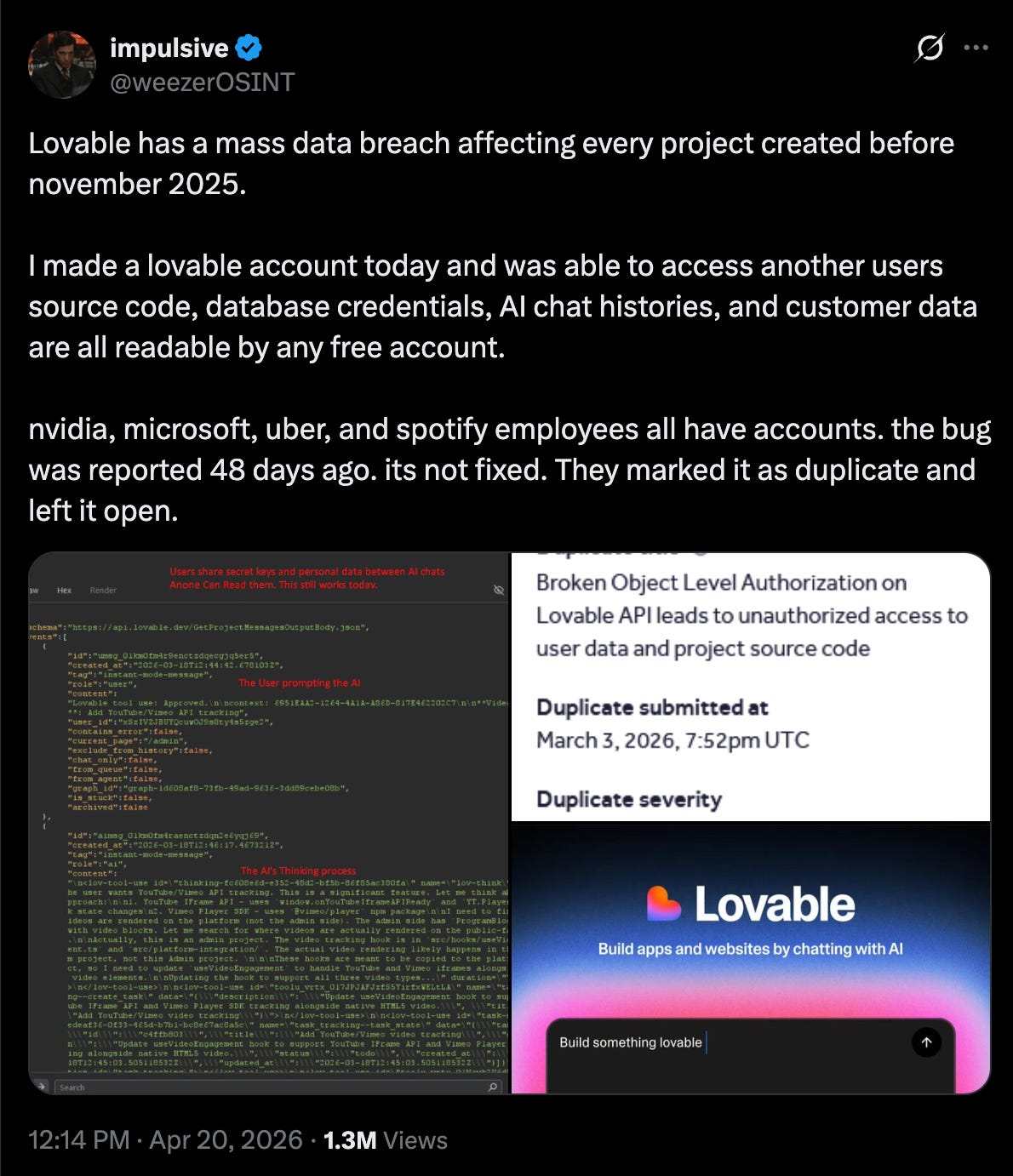
The April 20 disclosure that broke the vibe coding security illusion. A HackerOne report filed March 3 had been triaged and marked as duplicate, and never fixed. Source: @weezerOSINT on X.
For about eighteen months, vibe coding tools were absorbing a category of work that used to require engineering teams. Indie founders ship MVPs in afternoons. Designers prototype with real backend logic. Marketing teams build internal apps without filing a ticket. The trade was speed for safety, and most of us didn’t read the fine print. April was when the fine print got read out loud.
On April 20, security researcher @weezerOSINT publicly disclosed that any free Lovable account could read the source code, database credentials, AI chat histories, and customer data of every project created before November 2025. The vulnerability was a Broken Object Level Authorization bug. Lovable’s API granted access without checking whether the requester owned the resource. Free tier accounts, no special access needed. weezerOSINT noted that Nvidia, Mirosoft, Uber, and Spotify employees all had accounts in the affected pool.
Lovable’s initial response said there was no “data breach.” Three days later, the company disclosed it as a “permission regression.” A HackerOne report filed March 3, 2026 had been triaged and marked as duplicate, and never fixed. Forty-eight days of exposure between the original report and weezerOSINT’s public disclosure. Lovable’s most recent reported valuation: $6.6 billion.
The day before, on April 19, Vercel disclosed an unrelated incident. An attacker compromised a third-party tool used by a Vercel employee, then pivoted into internal Google Workspace and cloud environments. The chain matters here. The breach didn’t start at Vercel. It started at a tool Vercel trusted, and that trust was the lateral movement vector.
These two disclosures landed inside the same week. They share a structure. Tools that grew on speed-to-ship velocity, with security postures that hadn’t matured at the same rate, getting tested in production on a calendar they didn’t choose. The HackerOne triage at Lovable is the journalism. The cross-tool pivot at Vercel is the pattern.
One bug isn’t a market verdict, and Vercel responded fast and disclosed publicly. But the broader question is structural. Vibe coding tools now handle real money, real client data, and real production workloads. The security regime didn’t grow with the responsibility, and the disclosure cadence is starting to catch up.
Thanks for reading Eidos Design | UX AI Community! This post is public so feel free to share it.

SpaceX posted this on X a few hours before Cursor's $50 billion Series E was set to close. The round halted within 24 hours. 'Million H100 equivalent Colossus training supercomputer' is the part Cursor's investors couldn't match. Source: @SpaceX on X, April 22, 2026.
In mid-April, Cursor was on track to close a $2 billion Series E at a $50 billion pre-money valuation, co-led by Andreessen Horowitz and Thrive Capital with Nvidia participating. Sacra estimates the company hit $2 billion ARR in February 2026, up from $100 million in January 2025, the fastest B2B scale-up on record. The round was oversubscribed.
A few hours before the round was set to close the week of April 22, SpaceX posted on X that it had secured an option to acquire Cursor for $60 billion later this year, or alternatively to pay $10 billion for a development partnership running on its Colossus supercomputer. The $10 billion is guaranteed even if SpaceX walks. Cursor halted the Series E discussions within 24 hours.
The structure tells you what each side cares about. Cursor pays retail prices to Anthropic and OpenAI for the models that power its product. Those same labs ship Claude Code and Codex, which compete directly with Cursor. Multiple sources estimate Cursor was spending close to 100% of revenue on third-party model inference until its proprietary Composer model started compressing margins in late 2025. The $2 billion Series E wouldn’t have been enough to reach cash-flow breakeven; another raise was already coming. SpaceX, meanwhile, just merged with xAI and is widely seen as having an AI lab without an AI product. Cursor fixes that in one move. SpaceX is also delaying the actual acquisition until after its summer IPO, so it can finance the $60 billion in publicly traded stock.
Investors love optionality, founders love price tension, and SpaceX just bought time to defer the decision until after its IPO. The fastest-growing AI software company on record couldn’t close a $2 billion round on its own terms when a strategic buyer wrote a bigger check. The model-supply economics were already eating its margins, and the path to independence required raises bigger than venture capital alone could provide.
Application-layer companies whose long-term margin depends on which lab’s model they route to don’t get to make that decision freely. The cost of the model layer underneath dictates it. We’re entering an era where the design tools we use depend on financing structures we don’t see, and on strategic buyers who can write checks that pure financial investors can’t.
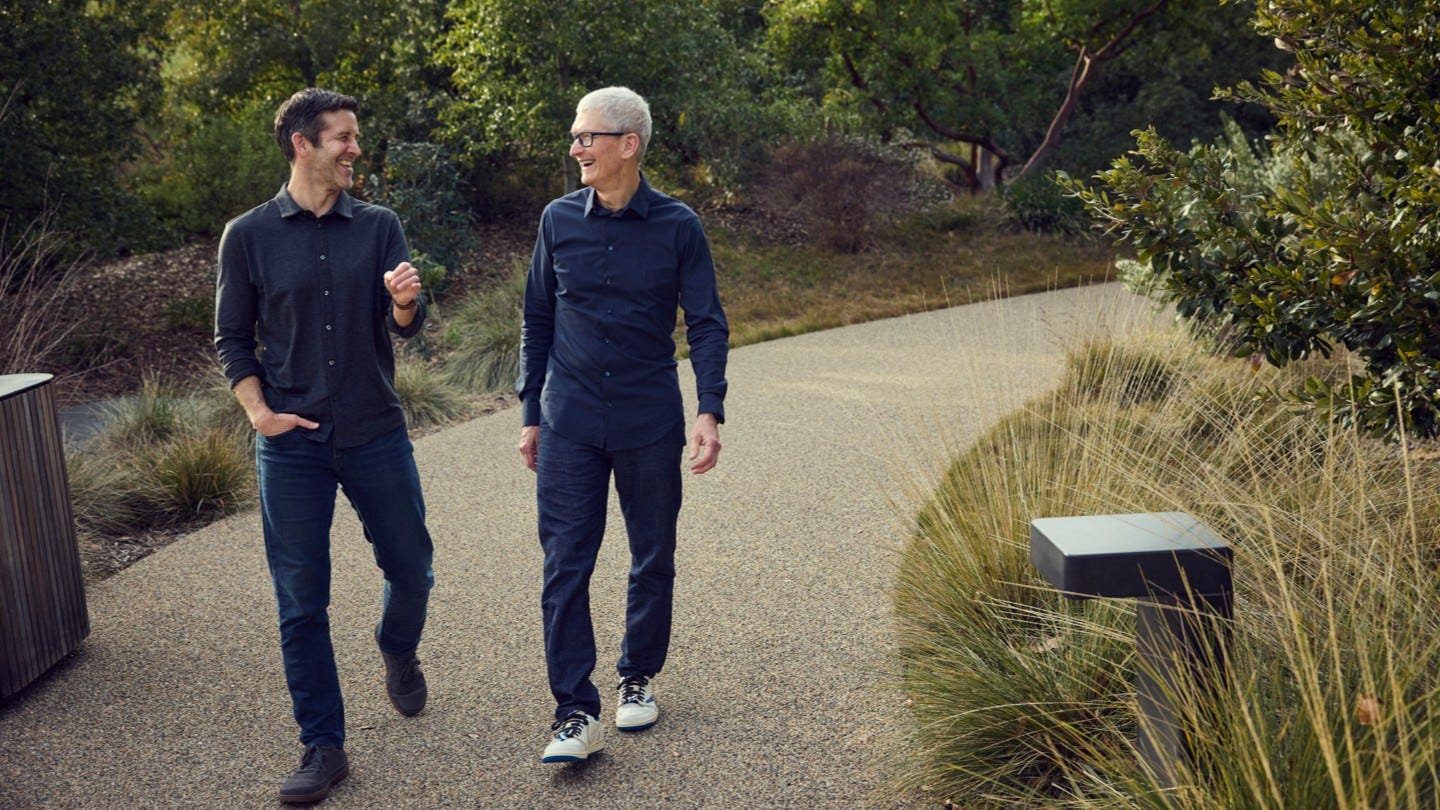
Tim Cook becomes Executive Chairman on September 1; John Ternus, SVP Hardware Engineering since 2021, takes over as CEO. Apple is positioning for the platform shift after the screen. Source: Apple.
On April 20, Apple announced Tim Cook will become Executive Chairman on September 1. John Ternus, 50, currently SVP Hardware Engineering, takes over as CEO. Ternus’s promotion is the part of the announcement that mattered.
Ternus has run Apple’s hardware engineering since 2021, which means every silicon decision, every battery decision, every camera and sensor decision for the iPhone 15, 16, 17, and Air, the M-series Macs, and the early Vision Pro shipped through his organization. He’s a hardware CEO inheriting a company at the moment its hardware bet matters more than its software bet for the first time in fifteen years.
The signals are all in the same direction. Bloomberg’s Mark Gurman reported four smart-glasses frame styles in testing, with production targeted for December 2026 and a launch in early 2027. Apple reportedly acquired Q.ai for over $2 billion to build subvocal interaction into AirPods Pro 3, paired with IR cameras. WWDC 2026 (June 8 to 12) promotional graphics teased an iOS 27 Siri redesign with a “Search or Ask” prompt in the Dynamic Island. The Vision Pro line has reportedly been deprioritized in favor of glasses-form-factor work.
Apple is positioning for the post-screen interaction era. The CEO change matters because Cook scaled the iPhone economy and Ternus knows how to ship novel hardware. The macro-environment is right for it. Meta’s Ray-Ban partnership has demonstrated demand for lightweight smart glasses, the AI lab race has produced models good enough to power ambient interfaces, and the smartphone supply chain has saturated.
Continuity is the easier read. Cook is staying as Executive Chairman, and the day-to-day will look continuous. But the signal is clear. Apple’s next platform isn’t a phone or a tablet. It’s wearable AI hardware that talks to you instead of being looked at, and the company just promoted the person whose career is shipping novel hardware to lead it.
👉 Emil Kowalski: Agents with Taste. Practical case for packaging design taste into Anthropic skill files. Kowalski breaks down why specific animation choices feel right (scale(0.95) instead of scale(0), easing flowcharts, duration guidelines), then converts each rule into structured input a coding agent can follow. His full design-engineering skill is installable via npx skills add emilkowalski/skill. The clearest answer I’ve read to the question of how taste survives the handoff to an agent.
👉 Garry Tan demos GStack on Y Combinator. YC President walks through GStack, his open-source toolkit that turns Claude Code into a multi-role engineering team via skills (Office Hours, Design, Code Review, QA, browser testing). The Office Hours skill is modeled on real YC partner sessions and pressure-tests your idea before you write a line of code. Free on GitHub. The clearest demonstration of skill-based agent teams I’ve seen this month.
👉 Josh Puckett: Melt Effect. A working tutorial on feTurbulence + feDisplacementMap for organic, hand-drawn-feeling distortion in SVG and CSS. Interactive sliders for every parameter, copy-paste filter, and a prompt at the bottom you can hand directly to a coding agent. Puckett also runs Interface Craft, his library “for those committed to designing with uncommon care.” This is what designers-who-build actually ship.
👉 Brian Lovin on Dive Club: How to level up with AI as a designer. Brian Lovin (Notion design) walks through his current AI tool stack, his Notion prototyping playground, why he’s back on Cursor, and how he thinks about career strategy for designers in the AI era. Includes the bookmarking side project Shiori he built solo. The most specific picture of a working designer’s AI process I’ve watched this year.
👉 Designer Tom interviews Diego Zaks at Ramp. Ramp is reportedly “the most AI-installed company in the world”: Anthropic visited the office because Ramp was using Claude Code more than Anthropic itself. Zaks (Head of Design) covers the four levels of AI fluency, how design changes when everyone is a builder, the 99.5% installed adoption story, and Glass (Ramp’s internal AI). The organizational counterpart to the individual-designer videos above.
👉 Gabriel Valdivia: I built a second brain out of markdown files. Fractional design partner Valdivia built a personal context layer pulling from Gmail, Slack, iMessage, Figma, Calendar, Granola, and Apple Health into a git repo of markdown files, plus 15 custom Claude Code skills that read, write, and cross-reference. The identity-profile section is the unsettling part: the system noticed his email tone with one client had shifted from enthusiastic to transactional before he had consciously admitted he was losing interest in the engagement. A mirror that gets sharper over time.
1. Audit which design tasks the labs now compete for directly. If your work is brief-to-comp loops, slide decks, marketing-page mockups, or first-draft explorations, that work now has a $20-per-month substitute that doesn’t open your design tool. Don’t panic. Just notice. Then ask: what part of my role is the labs not yet competing for? That’s where to invest your energy.
2. Get your content credentials in order before August 2. The EU AI Act’s Article 50 transparency obligations take effect August 2, 2026. AI-generated content must be labeled and watermarked in machine-readable format. Fines up to 15 million euros or 3% of global turnover. C2PA membership has crossed 6,000 organizations and is the de facto standard. Add Content Credentials to your export workflow now. Don’t wait until July.
3. Try Claude Design and Figma’s MCP and Paper.design in the same week. Build the same screen in each. Notice where each one wins, where each one fails, and where each one feels weird. The agent-era design stack is still forming. Designers who can talk specifically about the trade-offs between these tools will be valuable to clients in ways that designers who only know one tool won’t.
In April, every layer of the AI economy got renegotiated at once.
The labs are building products that compete with the platforms they depended on. The vibe coding stack got publicly audited by its own bug bounty. The financing structures underneath the application layer bent to compete with the model layer underneath them. And Apple promoted the person who’ll ship the platform after the screen.
AI has restructured every layer of the workflow design used to occupy, faster than the productivity that would justify it has shown up. The collaborative canvas is still ours. The institutional knowledge in your design system is still yours. The judgment about which of fifty AI-generated options actually serves the user is still yours. The first-draft layer is gone. Everything above it is still where the work lives. And the next interface (wearable, ambient, voice-first) is the next brief.
I keep coming back to something Soleio said recently: “The future belongs to designers who build.” I read that as more than encouragement to learn code. When the labs replace your tool, when the platform you ship on gets breached, when the model layer underneath bends the financing on top of it, the designers who own the full creation pipeline (designing and building as one act, not two) are insulated from any single layer’s disruption. Yann-Edern Gillet’s Rosetta Stone metaphor for design engineering points the same direction: the artifact that translates between languages is the one that holds when one language changes.
The question I’m sitting with: what does my role look like when every layer of the stack is being renegotiated at once? I don’t have a tidy answer. I’m building habits around skepticism, verification, judgment, and end-to-end ownership because those don’t expire when the tool changes. I suspect that’s most of the answer.
If this edition gave you something, share it with someone who needs to read it. And subscribe if you haven’t already. May is going to test all of these patterns.
Sincerely, Mykola Korzh